

Edmonton kitchen window guide
Steam. Grease. Reach. The blinds that survive a kitchen.
PVC-coated rollers, motorized over-sink reach, zebra blinds for the dining-area windows — the kitchen blinds that actually hold up in 2026 Edmonton homes.
A kitchen window has to put up with conditions no other room demands. Steam from boiling pasta. Grease aerosols from anything fried in oil. Direct splash from the sink below. Reach that’s two feet past where any normal person’s arm goes. And in most Edmonton kitchens, a south or west-facing afternoon sun that bleaches everything within 18 months.
That combination knocks out about half the blind options that work everywhere else in the house. Fabric drapes won’t last. Wood blinds warp. Plain horizontal blinds collect grease in every slat that no homeowner is ever going to clean. Cellulars are great thermally but a nightmare to wipe down once they’ve absorbed cooking smells.
The blinds that work in kitchens are a narrow shortlist. This guide covers what survives, what installs cleanly above an over-sink window, and how to handle the harder kitchen scenarios — open-concept rooms, motorized over-sink reach, west-facing afternoon glare on a kitchen island.
The short answer
For most Edmonton kitchens, roller shades in a wipe-clean PVC-coated fabric are the right answer. They roll up cleanly out of the way for cooking, they wipe down with a damp cloth in 30 seconds, and they install in any window depth. For an over-sink window where you can’t reach the chain, motorize them. For a kitchen window that doubles as a dining-area-defining feature (open-concept loft kitchen, bay window in a breakfast nook), zebra blinds earn the upgrade.
If you only have time for one decision: cordless or motorized roller shades in a wipe-clean fabric, neutral colour. They handle 90% of Edmonton kitchen window scenarios and cost the least.
What kitchens do to blinds
Three failure modes show up over and over in 5-year-old kitchen installs we walk into.
Grease accumulation in fabric weave. Anything you cook in oil — bacon, fries, stir-fry — releases an aerosol that travels several metres before it settles. Settled grease is sticky. Sticky surfaces collect kitchen dust. The result on a fabric-weave blind is a gradual yellow-brown discolouration that no laundering removes. Cellular shades and zebra blinds with rich-textured fabric are especially vulnerable.
Steam-induced sag and warping. Wood blinds and faux-wood horizontals over a stove or near a high-use kettle station absorb steam over time. The slats warp, the headers sag, and within 5 years the whole assembly is visibly drooping in the middle. Coastal-bathroom blinds get this same problem; kitchens with frequent steam are the inland version.
Water splash and moisture damage. Anything mounted within 18 inches of a sink eventually catches water — a forgotten dish rinse, a kid washing hands enthusiastically, a pot drained too aggressively. Fabric blinds wick the water and develop water rings. Wood and faux-wood swell. Plastic and PVC-coated rollers shrug it off.
The blinds that survive kitchens have three traits: they’re easy to wipe down, they don’t absorb steam or grease, and they roll fully up out of the cooking zone when you want them out of the way.
Tradeoff 1 — Roller shades vs zebra vs cellular for kitchens
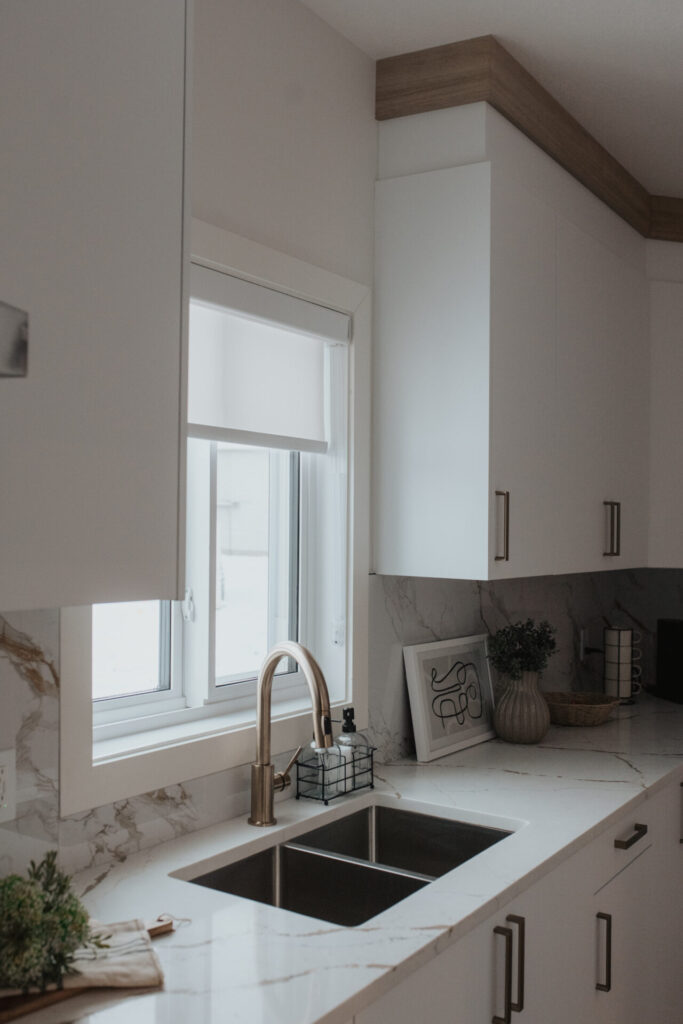
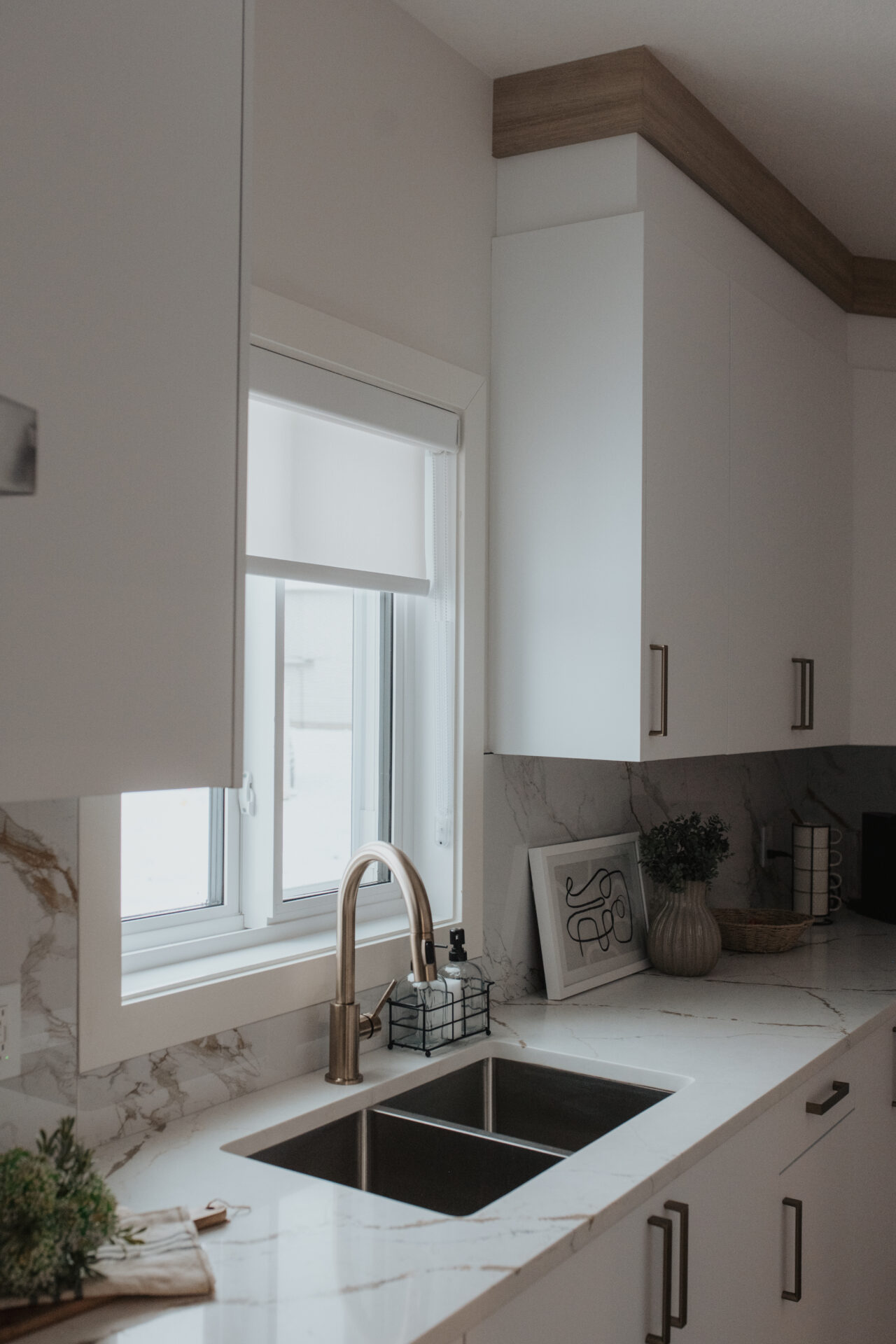
Roller shades win for over-sink and over-stove windows. A PVC-coated polyester roller is the kitchen workhorse. Wipe-clean surface, no fabric weave for grease to settle into, rolls fully up to clear the window for steam venting. Light-filtering or blackout fabric depending on how much daytime privacy you want. Cordless lift is the standard; motorized for any window where you can’t reach the chain.
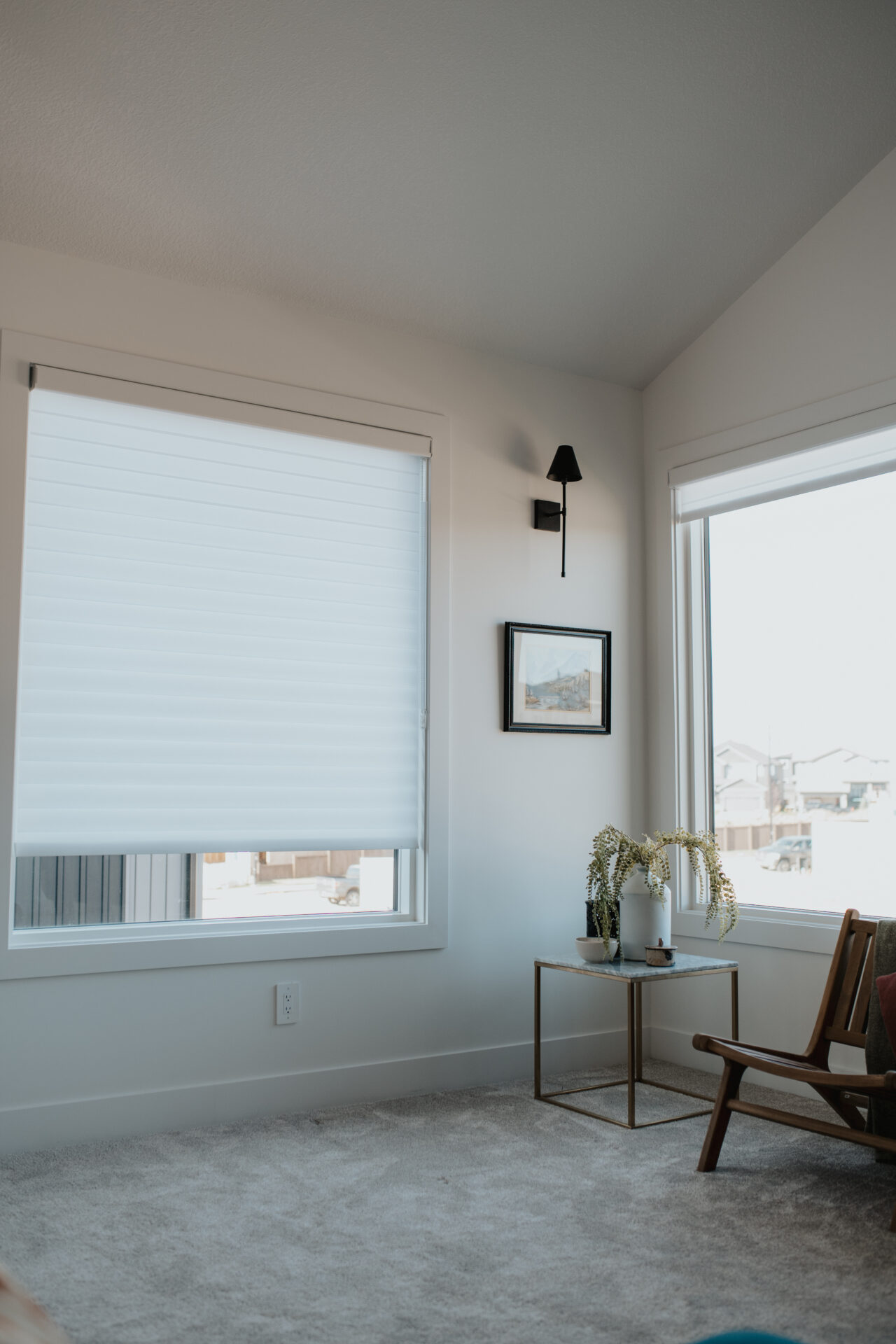
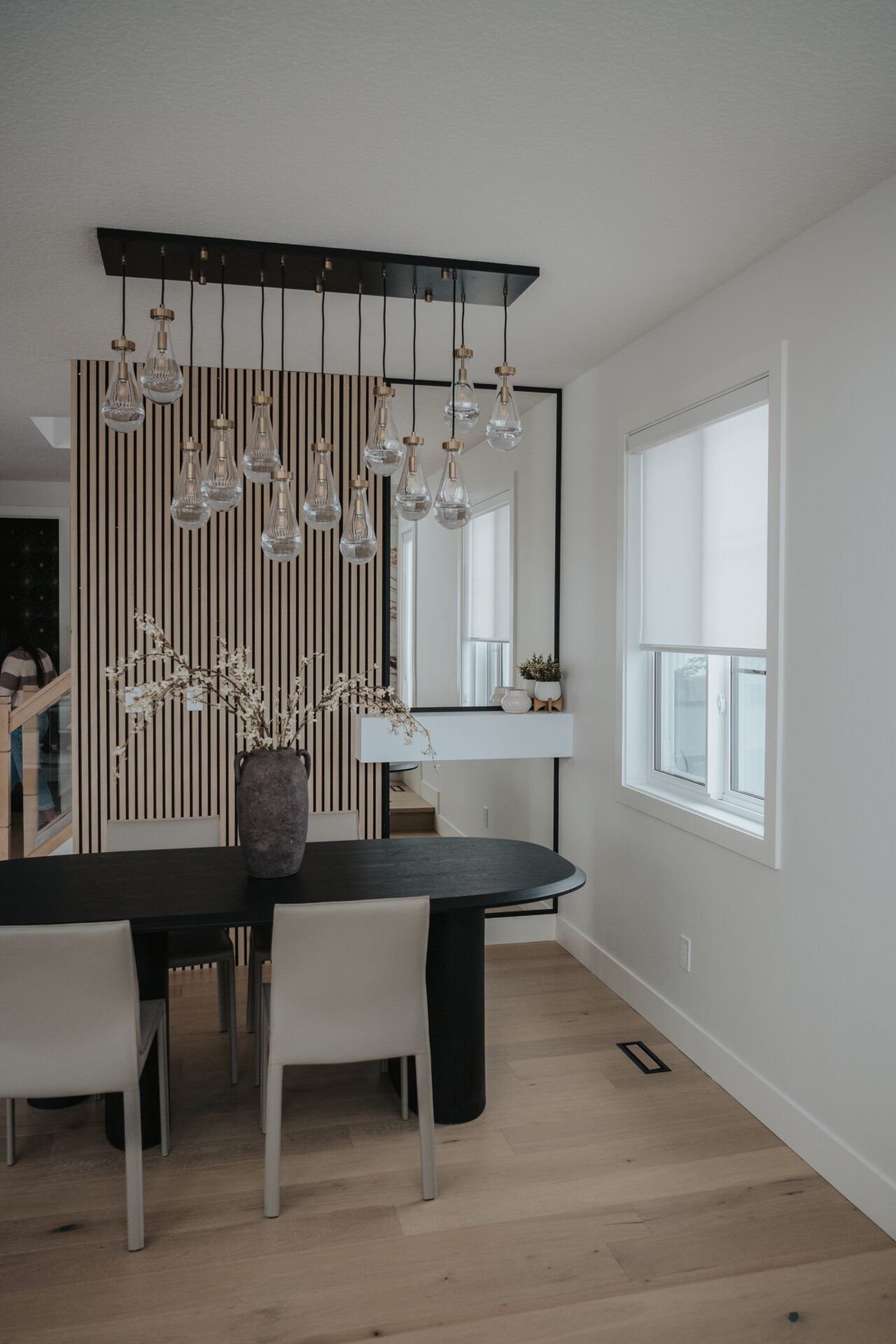
Zebra blinds win for breakfast-nook and dining-area kitchen windows. If the kitchen window is part of an open-concept living/dining/kitchen layout and the window itself is more decorative than functional (no sink underneath, no stove nearby), zebra blinds earn the upgrade. They tune light and privacy through the day in a way rollers can’t, and the visual texture pairs better with dining-room furniture than a flat roller does. We covered the broader zebra-vs-roller decision in our most-read comparison post.
Cellular shades lose in kitchens. The honeycomb structure that makes cellulars great thermally also makes them grease-magnets. The fabric weave traps cooking aerosol that’s almost impossible to clean without specialized equipment. Save cellulars for bedrooms and living rooms — they’re not the right kitchen product.
Vertical blinds and horizontal mini-blinds also lose. Both have a slat structure that catches grease in every interior fold, and both look dated in modern Edmonton kitchens. Skip both for new installs.
Tradeoff 2 — Motorized vs cordless for over-sink reach
For an over-sink window, motorization is one of the highest-leverage upgrades in the house. Reaching across a 24-inch sink to grab a chain dangling 60 inches up means leaning over a wet sink, sometimes with hot pots, on a daily basis. Most homeowners just leave the over-sink shade closed all day to avoid the reach, which means the kitchen always looks darker than it should.
A motorized over-sink roller eliminates that — one tap on the wall switch or one voice command to the smart speaker and the shade rolls up cleanly out of the way. Pair with a kitchen motorized setup that also handles the dining-area windows and the whole kitchen feels different.
For a typical 36-inch wide over-sink window, the motor adds about $200 to $300 over a cordless lift in 2026 Edmonton pricing. It pays for itself in daily ease within a single year.
Tradeoff 3 — Inside mount vs outside mount for kitchen windows
For kitchens, outside mount usually wins because most kitchen windows are surrounded by tile, backsplash, or sink-area surfaces that don’t accommodate a clean inside-mount header. An outside-mount also keeps the fabric clear of any moisture or splash that lives in the window well itself.
The exception: dining-area kitchen windows in open-concept layouts where the trim is finished drywall (no tile, no backsplash). Inside mount looks cleaner there.
For an over-stove window specifically, outside mount with the bottom of the shade clearing the stove top by at least 12 inches is the safe install. Some homeowners want the shade to clear the stove fully (24-inch clearance for any open-flame cooking). Discuss with your installer at the consultation.
Best by kitchen type
- Suburban two-story with a single over-sink window facing the backyard: motorized PVC-coated roller, light-filtering, neutral colour. About $250 to $400.
- Open-concept loft kitchen with three large dining-area windows facing west: zebra blinds across all three, motorized, mid-grade fabric. The dining area becomes more useable in summer afternoons. $1,200 to $1,800 total.
- Galley kitchen with a small egress window high on the back wall: plain blackout roller in white, cordless. Cheap, simple, blocks the unwanted morning sun on the breakfast bar. $140 to $220.
- Older Edmonton bungalow kitchen with a wood-trimmed over-sink window: PVC-coated roller in a colour that complements the trim, motorized. Modern function in a heritage room. $300 to $450.
- Bay window breakfast nook (kitchen-adjacent): three coordinated zebra blinds across the bay, with the centre window potentially motorized. Clean look, tunable through the day. $900 to $1,400.
- Kitchen island with a large skylight or transom above: specialty motorized roller for skylight reach (we do these — ask at consultation). Cordless with a long pole is the budget alternative.
Kitchen-tested installs
Real Edmonton kitchens, real survival.
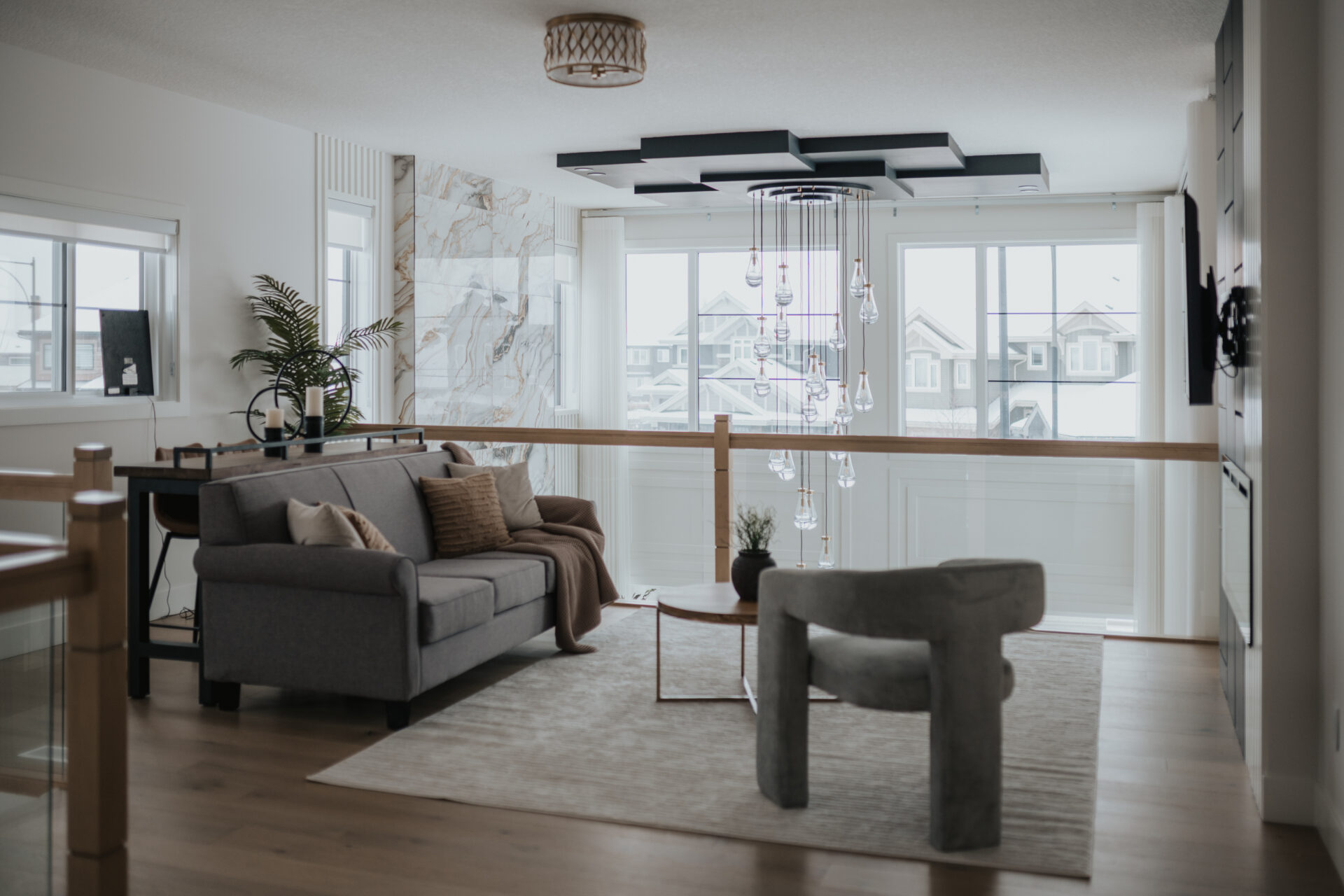
The Edmonton angle — kitchen sun is unforgiving here
Most Edmonton kitchens are at the back of the house facing south or west, because the original architects (and most modern builders) put the formal living spaces facing the street and the family/kitchen spaces facing the backyard. Those backyards face south or west in roughly 60% of Edmonton lots.
The result: the kitchen window or windows take direct afternoon sun for 4 to 6 hours from late May through August. Heat-stressed counters, faded backsplash tile, glare on the kitchen island, and a dishwashing experience that means standing in direct sun every evening at 6 PM. The right blinds don’t just look good — they make the kitchen useable through the worst summer afternoons.
For west-facing kitchen windows specifically, a darker fabric (charcoal, espresso) handles glare better than white. The instinct is to go light because kitchens generally read bright and clean — but on a west window, the dark fabric reduces the room’s heat load while still rolling up cleanly out of the way when you want light.
Common kitchen blind mistakes
- Wood or faux-wood blinds anywhere near a stove. They warp from steam exposure within 5 years. Always.
- Cordless chain over a sink with no quick-release. Leaning over a wet sink to operate the blind is the daily reason most kitchen blinds end up permanently closed. Motorize or skip the kitchen window covering entirely.
- Cellular shades behind the stove. Grease accumulation ruins them within 24 to 36 months. Roller is the answer.
- Light-coloured fabric on a west-facing kitchen window. Reflects glare back into the room. Go darker than your instinct.
- Skipping the kitchen window because “we don’t really use it.” A good kitchen window covering reduces heat load, glare, and afternoon sink-stand discomfort. It pays off every day, not just on the days you notice it.
- Mismatching the kitchen blinds to the rest of the house. Kitchen rollers in a similar tone to the dining-area zebras keep the open-concept space visually coordinated. Random fabrics make the room read like an accident.
Final take — what we’d actually install in an Edmonton kitchen
If you handed us a typical Edmonton kitchen — south or west-facing backyard window, a sink under it, a few dining-area windows nearby — here’s what we’d do.
- Over-sink window: motorized PVC-coated roller, light-filtering, neutral colour matching the cabinet tone. About $300 to $400.
- Over-stove window (if any): outside-mount cordless roller, blackout fabric for full-shut option, mounted with stove clearance. About $200 to $300.
- Dining-area kitchen windows (2 to 4 of them): zebra blinds, mid-grade fabric, cordless or motorized depending on reach. About $900 to $1,800 total.
- Pantry or laundry-adjacent kitchen window: plain blackout roller. Cheap, fast install, done. $140 to $220.
Total for a comprehensive kitchen package: $1,500 to $3,000 depending on motorization choices and number of dining-area windows. Smaller kitchens with just an over-sink window can be done for $300 to $500.
Drop one of these into your kitchen with the free room visualizer before deciding on fabric. It’s the easiest way to see how a darker roller actually reads against your backsplash.
Ready to upgrade the kitchen?
Book a free in-home consultation across Edmonton, Sherwood Park, St. Albert, Leduc, Spruce Grove, Fort Saskatchewan, Beaumont, Stony Plain, Grande Prairie, and Red Deer. We’ll measure each window, talk through which fabrics survive your specific cooking style, and send a written quote within 48 hours. Book your consultation or call 780-245-0190. Browse the photo gallery for finished kitchen installs across the metro region.
If you’re in the middle of a kitchen renovation and the blinds need to coordinate with new cabinets and countertops, mention that at booking — we’ll bring fabric samples that pair well with common cabinet finishes.
Frequently Asked Questions
What blinds are best for a kitchen window over a sink?
Motorized PVC-coated roller shades in a light-filtering or blackout fabric. The motorization eliminates the daily reach across the sink, the PVC-coated fabric wipes clean of cooking residue, and the roller form factor rolls fully up to clear the window for steam venting. Cordless rollers work if the chain is reachable without leaning over the sink, but for most over-sink installs the motorized upgrade pays off in daily ease.
Are wood blinds OK in a kitchen?
Generally no, especially over a stove or near frequent steam. Wood and faux-wood blinds absorb moisture from steam exposure and warp within 3 to 5 years. They also collect grease in every slat that’s nearly impossible to clean. PVC-coated rollers or sealed-fabric zebras handle kitchen conditions better. Save wood blinds for living rooms and bedrooms where moisture isn’t a daily issue.
How do you clean kitchen blinds?
For PVC-coated rollers, wipe down with a damp microfiber cloth and mild soap every 4 to 8 weeks. For zebra blinds in dining-adjacent kitchens, vacuum with a soft brush attachment monthly and spot-clean grease with a foam cleaner. Avoid harsh solvents on any blind — they damage the fabric coating. Cellular shades in kitchens (not recommended) require professional cleaning.
Can I get motorized blinds over a kitchen sink?
Yes, and it’s one of the best motorization use cases in the house. The reach across a sink is awkward and risky with hot pots or full hands. A wall switch or voice command to a smart speaker eliminates the daily inconvenience. Pair with the rest of your kitchen on the same controller for a unified setup — see the motorized blinds page for compatibility details.
How much do kitchen blinds cost in Edmonton in 2026?
A custom 36-inch by 48-inch over-sink roller (light-filtering, cordless) runs $180 to $280. The same shade motorized runs $380 to $560. A zebra blind for a dining-area kitchen window in 60-inch by 60-inch size runs $260 to $420 cordless or $400 to $640 motorized. A typical comprehensive kitchen package (over-sink, over-stove, 2 dining-area windows) lands $1,500 to $3,000.
What fabric is best for kitchen window blinds?
PVC-coated polyester is the kitchen workhorse — wipes clean, doesn’t absorb grease or steam, durable for 10-plus years. For dining-adjacent kitchen windows that don’t see direct cooking exposure, mid-grade textured polyester in zebra format works well. Avoid linen, natural-fibre, or open-weave fabrics — they all wick grease and steam. Avoid pure cotton — it stains and shrinks with steam exposure.
Should kitchen blinds match the rest of the house?
Coordinate, but don’t necessarily match. Kitchen function differs enough from living areas that a different product (roller vs zebra, for example) makes sense. Match the fabric tone or finish across products so the open-concept areas read coordinated rather than random. Our consultants bring swatches for both rollers and zebras so you can see how they pair side by side.
Get the kitchen window done right.
Free in-home consultation. We measure each window, talk through which fabrics survive your cooking style, and send a written quote within 48 hours.
Book free consultationServing