

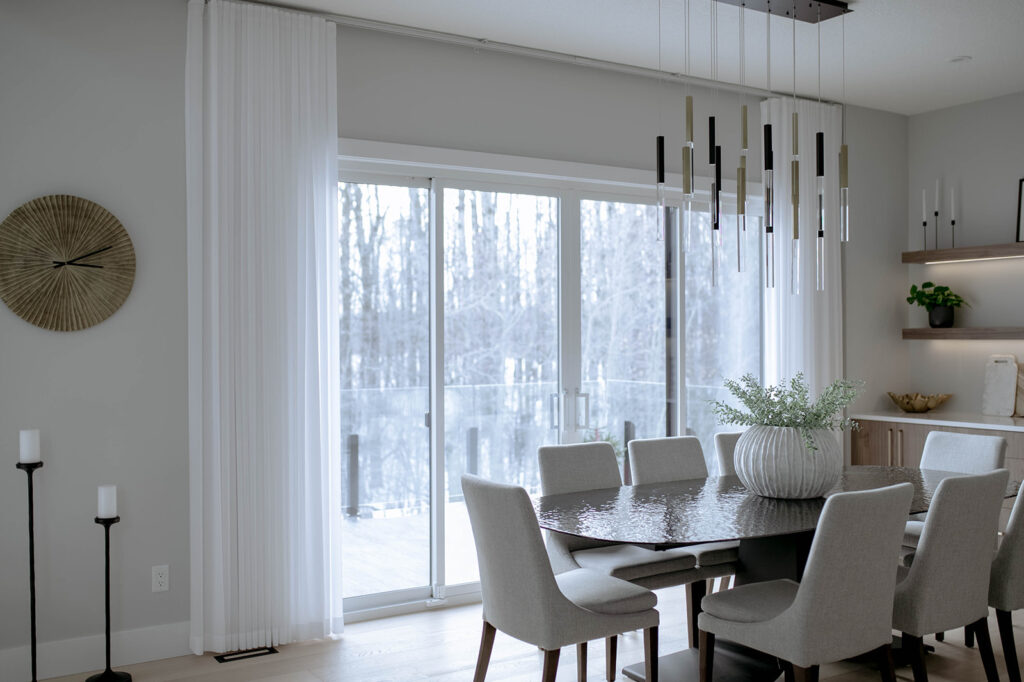
For a patio door you use throughout the day, start by comparing vertical sheers with a split roller arrangement. Vertical sheers move sideways; separate roller shades may let you raise the covering over the access panel while keeping adjacent glass covered. The right choice depends on the door’s movement, the available mounting space and the privacy you need after dark.
One wide shade can suit an opening you use less often. It is less convenient when you have to raise the whole covering each time you step outside. Start with access, then choose the fabric.
Map the door before choosing the covering
Open the door and look at what actually moves. A sliding door may have one moving panel beside fixed glass. French doors swing into or out of the room. A larger opening may include several moving panels, so a simple two-shade plan may not match the way it works.
Check the projecting handles, locks and trim. Note furniture beside the door and the wall or ceiling area available for mounting. The covering must clear the handle, and its fabric or stack must leave the passage usable.
Take a straight-on photo and a second photo with the door open. Approximate dimensions are useful for the first conversation. Final measurements and the proposed hardware determine what can be ordered.
Compare vertical sheers and roller shades
| What you need | Start with | What to check |
|---|---|---|
| Frequent access and soft daylight | Vertical sheers | Drawing direction, stack location and the space left for passage |
| Independent coverage over fixed and moving glass | Split roller shades | Whether shade divisions can align with the door panels; the gap at each join |
| A simple covering for an occasionally used door | A single roller shade, if suitable | Fabric and hardware limits, operating weight and the need to raise it for access |
| A darker room with a patio door | Blackout roller fabric | Edge gaps, overlap and clearance; blackout fabric alone does not guarantee darkness |
| Easier control of high or wide shades | Motorized rollers, if suitable | Motor and power configuration, individual or grouped control and door clearance |
These are starting points for a measure, not universal fit rules. There is no single width limit that applies to every fabric, control and opening.
Vertical sheers: a useful starting point for a busy door
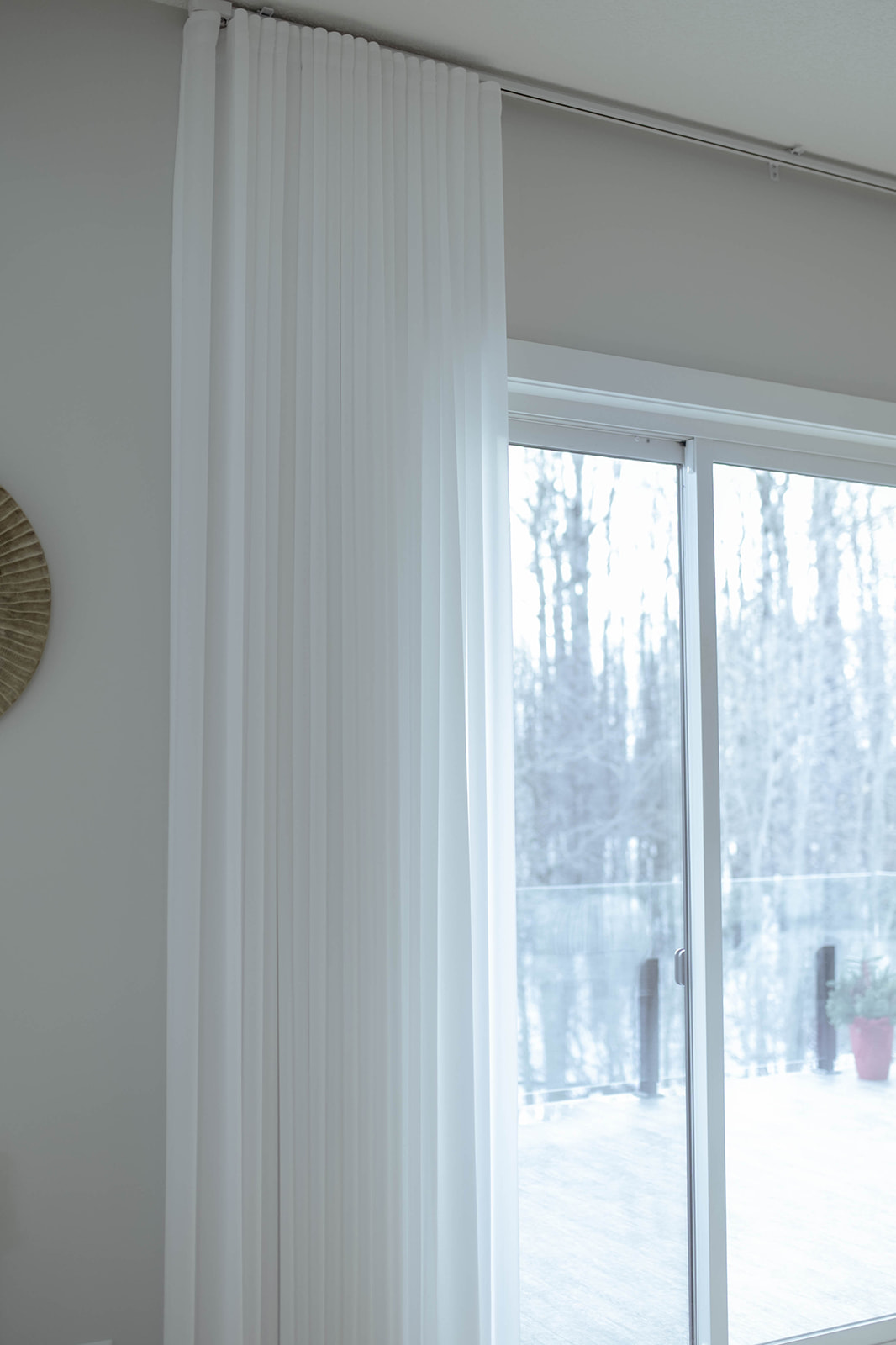
Vertical sheers combine a soft fabric appearance with adjustable vertical vanes. They can filter daylight, close for more privacy and draw sideways to make room for access.
The practical question is where the fabric goes when open. A stack on the access side can crowd the route outside. Drawing to the opposite side, or another arrangement, may work better where the track and room permit it. Ask to see the proposed stack position with the door fully open.
Vertical sheers are distinct from traditional vertical blinds. Choose them because their light control and movement suit the room. Their appearance does not tell you how much privacy a particular fabric provides at night, so compare samples and the closed position before ordering.
Roller shades: one wide shade or a split arrangement?
Roller shades roll upward, leaving a flat fabric surface when lowered. They suit a simple interior and let you choose light-filtering, sunscreen or blackout fabric.
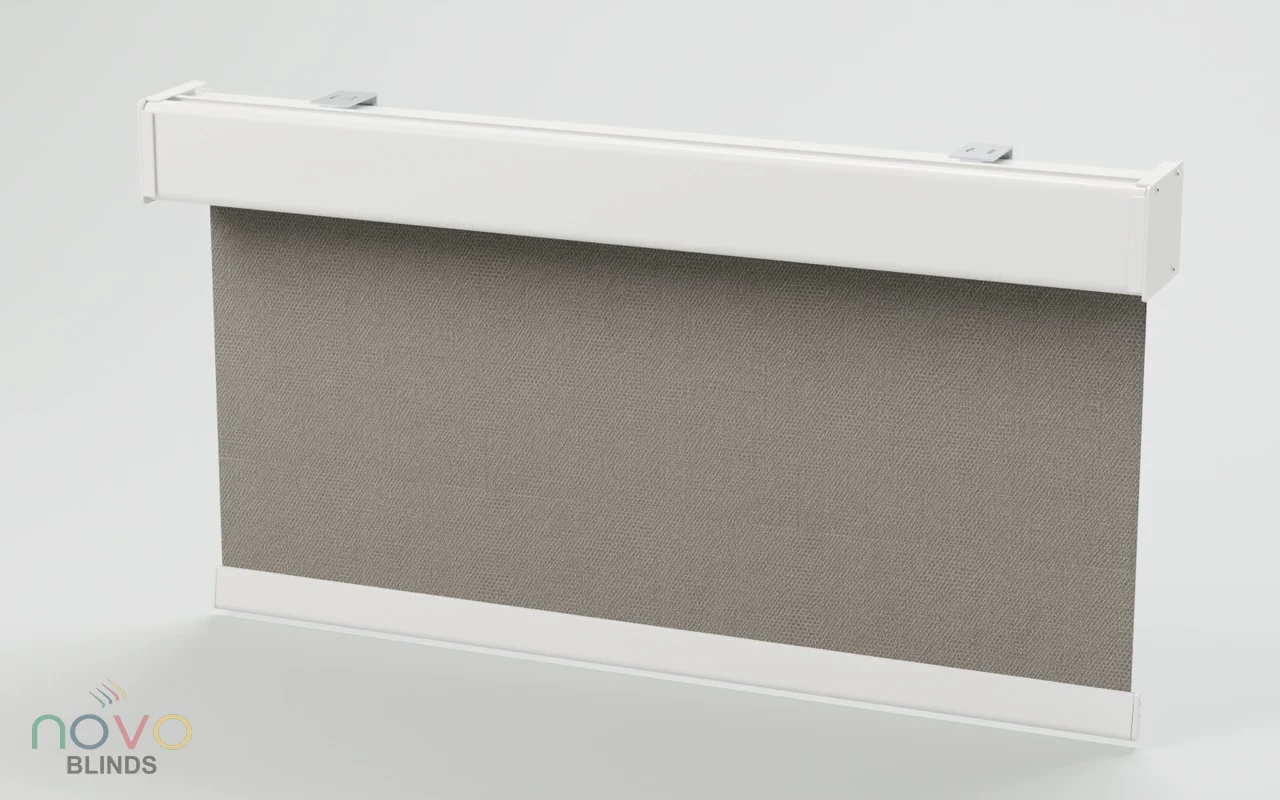
With one wide shade, the full opening is covered together. You need to raise it clear of the passage before using the door. That may be fine for occasional access, but it is worth reconsidering for a frequently used balcony or backyard door.
Separate rollers can make access more flexible. Where the layout permits, the shade over the moving panel can rise while the fixed panel stays covered. Ask whether the division aligns with the door frame and whether the hardware clears the handle as the door moves.
The tradeoff is a gap between the shades. Splitting a bedroom patio opening for convenient access can leave a line of light at the join. Discuss that gap alongside any edge-light treatment; do not assume a split configuration will deliver uninterrupted darkness.
Daytime glare and nighttime privacy need separate checks
Sunscreen fabric can soften glare while keeping some outward view. It should not be treated as nighttime privacy fabric. When it is darker outside and the room is lit, visibility through the covering changes.
For a living room, compare how a sample handles daylight and ask what someone outside may see after dark. For a bedroom with a patio door, start with opaque blackout fabric and discuss the whole opening, including edges and joins. Our blackout blinds guide explains why fabric and fit need to be considered together.
Sheers can be useful for adjustable daylight, but their closed position and fabric must match your evening privacy needs. If one fabric cannot meet both needs, discuss an appropriate layered arrangement and its clearance rather than expecting a see-through material to do both jobs.
Motorization helps with operation; clearance still matters
A motorized roller can make a large or hard-to-reach shade easier to use. It still needs to rise clear of the route before you open or pass through the door.
A remote can operate a compatible shade without a smart-home hub. Add a compatible hub for Google Home, Alexa or Siri through Apple HomeKit. Confirm the selected motor, hub and platform together, especially if you want separate control of several shades. See our motorized blinds guide before choosing a setup.
Confirm the power supply and how you will reach it for charging or servicing.
What about curtains, panel tracks and cellular coverings?
Curtains can frame a patio door, but open panels still need somewhere to stack. Novo offers curtains as a resold line. Include the fabric, track, stacking space and installation in a specific quote; they are not manufactured by Novo.
If you are considering panel tracks or a sideways-stacking cellular covering, ask us to confirm availability and suitability for your opening before planning around that product.
For a first Novo consultation, vertical sheers and roller configurations are the clearest starting points.
Before ordering in a condo
Obtain your building’s requirements for the outside appearance of window coverings and any restrictions on mounting or installation. Bring the actual requirements to the measure. A white backing or a particular mount should not be assumed to satisfy every building’s rules.
Include balcony-door operation, tall glass, handle clearance and access for the installation. In Surrey and Vancouver, our Lower Mainland cost guide explains why sizes, controls and installation scope matter more than window count alone.
Our recommendation
For frequent traffic and soft daylight, start with vertical sheers and check the stack. For a flat finish and independent panel coverage, ask about split rollers and the light gap at the join. For occasional access, a single roller may be suitable after the fabric and hardware are checked.
A free initial in-home consultation includes measuring and samples within Novo’s direct service areas. We assess the opening and provide an itemized written quote after measuring. Request a consultation for Edmonton or Metro Vancouver, including Surrey and Vancouver.
Frequently asked questions
Can I leave part of the glass covered while using the door?
A split roller arrangement may allow that where the shade division matches the fixed and moving panels. We need to check the door’s travel, handles and mounting positions before confirming it.
Will vertical sheers give privacy at night?
That depends on the fabric and closed position. Compare the actual material and ask about visibility with interior lights on; a daytime view is not enough to judge it.
How wide can a patio-door shade be?
The limit depends on the fabric, hardware and control. We confirm whether a single shade is suitable or the opening needs separate coverings after assessing the dimensions and daily access.
Can a shade fix a cold or draughty patio door?
A covering may help with comfort, but it does not repair worn seals or a leaking frame. Have the door’s condition checked if you can feel a draught, and choose the covering for access, light and privacy without assuming an energy-saving percentage.