

Novo Blinds · Edmonton
Best Blinds for French Doors: Light, Privacy, and a Clean Stack
French doors need coverings that clear the handle, stack tight, and look good open or closed. Roller, cellular, and sheer options compared for Edmonton homes.
French Door
Specialist
3–5 wk
Lead Time
4.8★
Google Rating
French doors look beautiful until you try to cover them. The handles stick out six inches from the glass. The doors swing inward or outward on hinges, and anything mounted too close gets caught in the arc. The glass panels are narrow — often 20 to 24 inches wide — which rules out most standard-width shades. And because French doors come in pairs, whatever you choose has to look symmetrical when both doors are closed and stay out of the way when both are open. Stock blinds from a box store won’t solve this. The geometry of a French door demands coverings that are measured, mounted, and built specifically for the door. The short answer: For most French doors, top-down/bottom-up cellular shades or slim roller shades mounted inside the glass panel are the best option — they clear the handle, stay flat against the glass, and don’t interfere with the swing. For French doors that open onto a patio or deck, vertical sheers or curtain panels on a bypass track give you the stacking clearance you need when the doors are in constant use.
Why French Doors Are Different From Every Other Window
Four things make blinds for French doors harder than blinds for standard windows. Handle clearance. French door handles — lever-style or knob — extend 4 to 6 inches from the glass surface. Any shade that hangs loose will catch on the handle every time the door opens. Inside-glass mounting keeps the fabric recessed behind the handle’s reach. Outside-frame mounting clears it by going wider, but adds bulk to the door face. Swing radius. French doors hinge at the side and swing 90 to 180 degrees. Whatever is mounted on the door travels with it. Anything that dangles, swings, or rattles during the arc — corded blinds, loose fabric, heavy drapery — becomes a noise problem and a wear problem. Coverings need to sit tight against the glass and stay anchored during motion. Narrow panel width. A single French door panel is typically 20 to 28 inches of glass width. Most standard blinds start at 24 inches and go up. That tight width means your covering options are limited to products that can be custom-cut narrow and still operate cleanly — no bunching, no binding in the brackets. Paired symmetry. French doors come in pairs. If one shade sits a quarter-inch higher than the other, or one fabric is slightly more taut, you see it immediately. The alignment has to be precise across both doors, and the hardware on each door has to be identical in position and tension.French Door Window Coverings: Option by Option
Cellular shades — top-down/bottom-up
This is our most-recommended French door covering for bedrooms, dens, and any room where privacy and light flexibility both matter. A top-down/bottom-up cellular shade lets you lower the top half for daylight while keeping the bottom half raised for privacy — or close the whole thing for full coverage. On a French door, the shade mounts inside the glass recess with hold-down brackets at the bottom rail. Those brackets keep the shade pinned flat against the glass so it doesn’t flap when the door swings. The honeycomb cells add insulation against the glass — meaningful on a French door that leads to a cold patio or balcony in January. Cordless operation is non-negotiable here. A pull cord on a French door catches on the handle, wraps around the hinge, and becomes a hazard for kids and pets. Every cellular shade we install on French doors is cordless or motorized. Best for: bedrooms, dens, nurseries, any French door where you want privacy + light control + insulation. Budget $280 to $520 per door panel in 2026 Edmonton pricing, cordless. Add $200 to $350 per panel for motorization.Slim roller shades
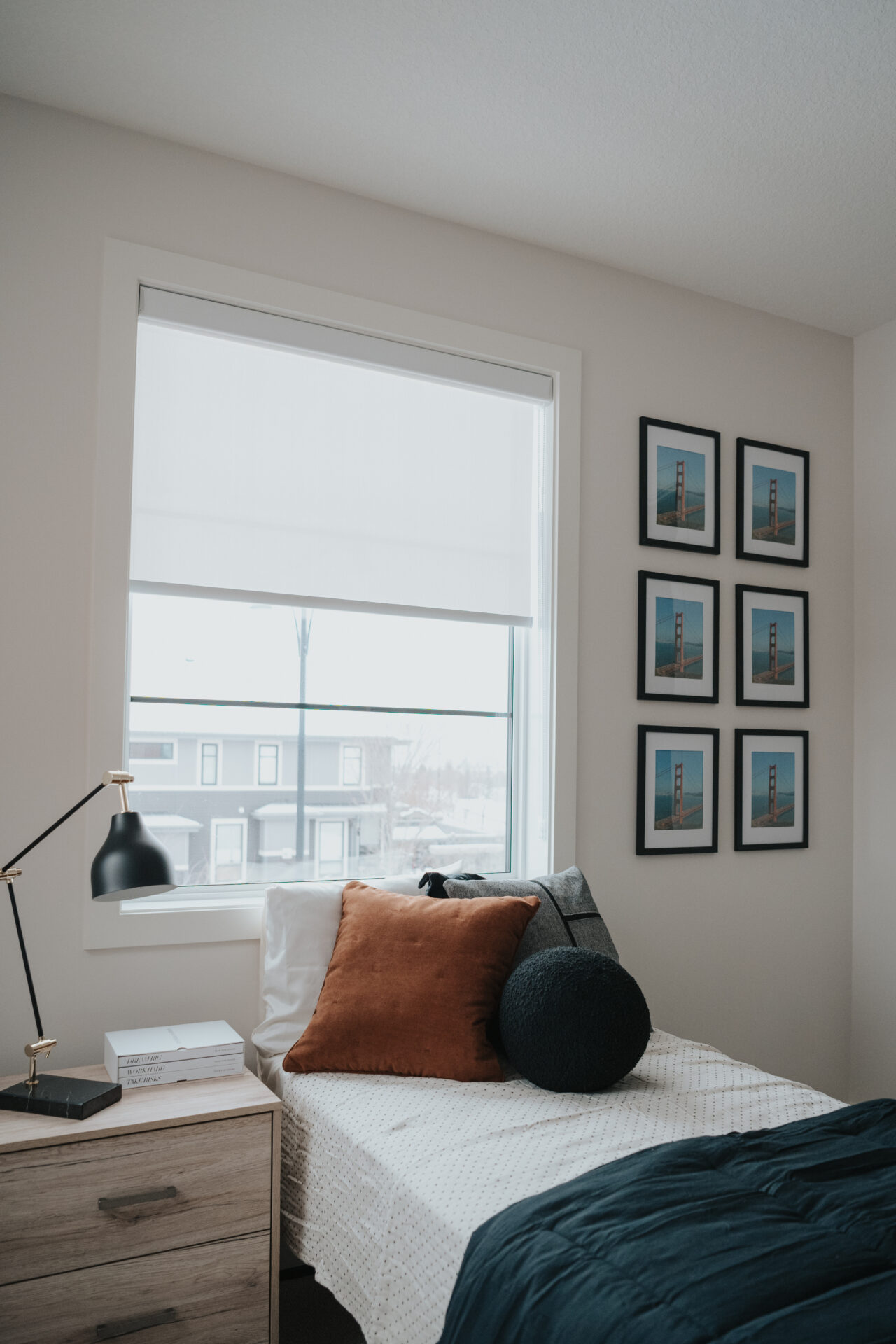
Roller shades are the minimal-profile option. A single tube at the top, fabric that rolls down flat against the glass, and a slim bottom rail that tucks behind hold-down clips. On a narrow French door panel, a roller shade disappears almost completely when raised — just a 2-inch cassette at the top of the glass. When lowered, the fabric sits perfectly flat with zero stack depth. The key is the cassette and bracket size. A standard roller cassette is 3 to 4 inches deep. On a French door with shallow glass recess, that cassette might protrude past the handle plane. We use low-profile cassettes — 2-inch depth — for French door installs to keep everything behind the handle’s reach. Fabric choice matters here. Light-filtering roller fabric gives you daytime privacy without killing natural light. Blackout roller fabric turns the French door into a solid barrier — useful for French doors in bedrooms or media rooms. Solar screen fabric (1% or 3% openness) preserves your view while blocking UV and glare — the right call for French doors that face a garden or patio you want to see through. Best for: modern and minimalist spaces, French doors where you want the covering to vanish when open. Budget $220 to $440 per door panel, cordless. Motorized adds $200 to $350 per panel.Vertical sheers
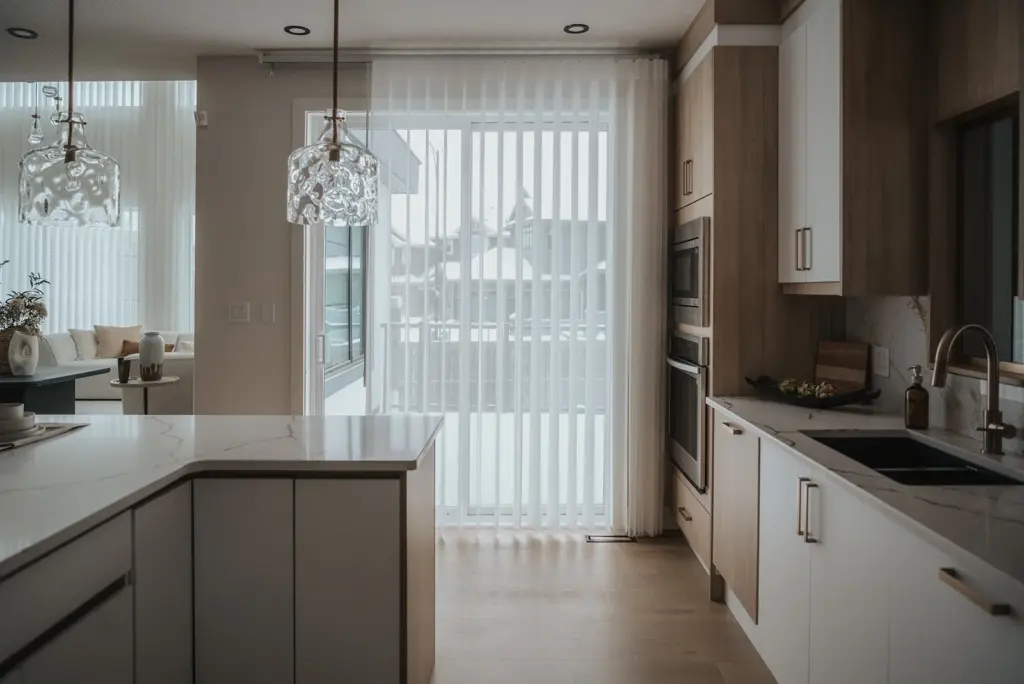
Vertical sheers are a hybrid — soft fabric vanes suspended between two sheer layers, gliding sideways on a headrail. They’re the best-looking option for wider French door configurations that include sidelights or transoms. The vanes rotate to control light angle, and the whole panel slides to one side for door access. On a standard pair of French doors without sidelights, vertical sheers can work but they require a headrail mounted above the frame — not on the door itself. That means the sheers stay stationary while the doors swing underneath them. This is actually an advantage: the sheers don’t travel with the door, so there’s no flapping, no rattling, and no wear on the hinge. The tradeoff is that you need 6 to 10 inches of wall space on one side (or both sides) for the sheers to stack into when open. For a deeper comparison of vertical sheers against other patio-door options, our patio door blinds guide covers stacking clearance, insulation, and pricing in detail. Best for: French doors with sidelights, wide French door openings, formal living rooms. Budget $600 to $1,200 for a full two-door-plus-sidelights configuration.Curtain panels on a bypass track
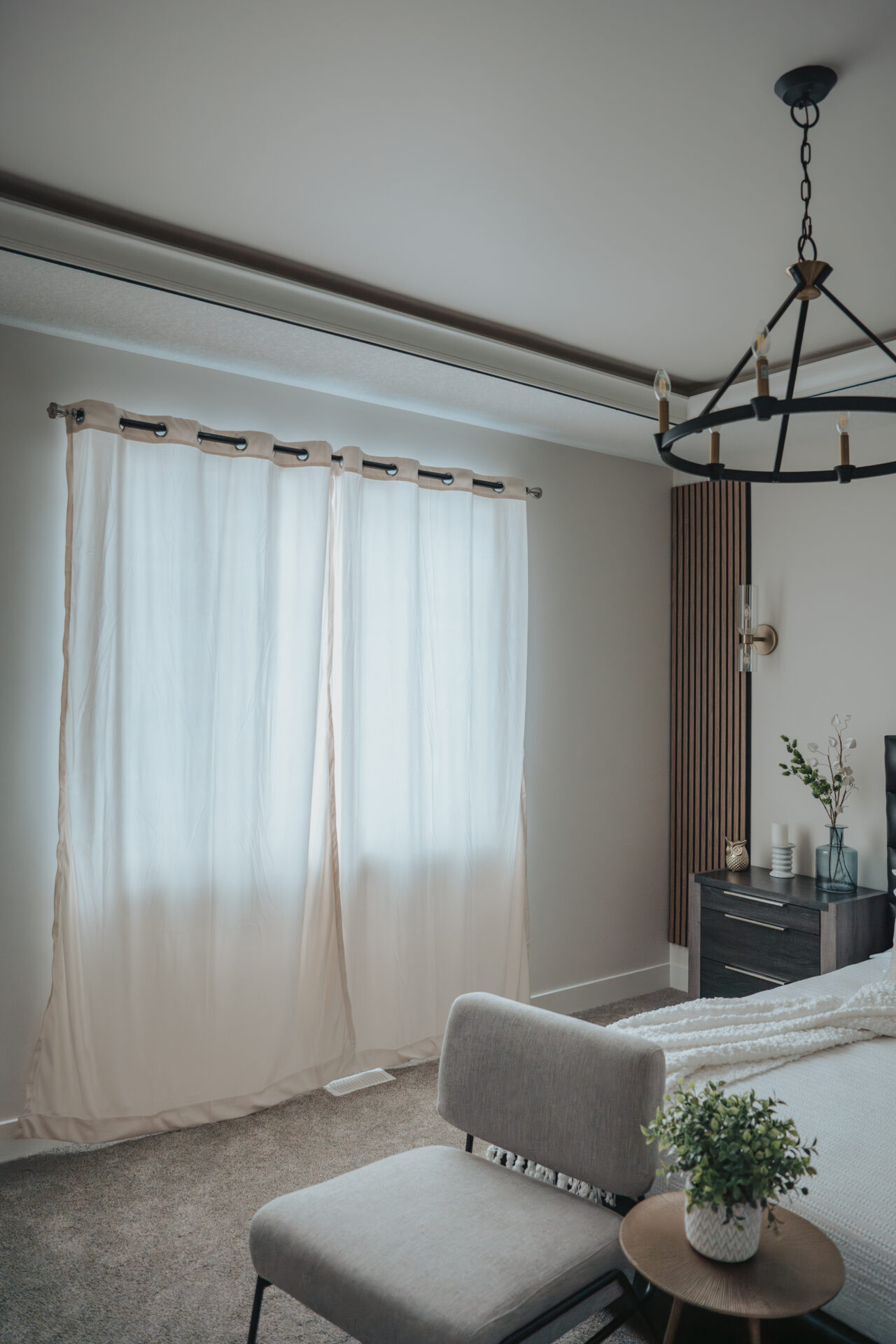
This is the traditional look — fabric panels that slide past each other on a multi-channel track. Curtains for French doors work best when the doors are purely decorative (rarely opened) or when the aesthetic priority outweighs daily convenience. Linen, velvet, or thermal-lined fabric in floor-length panels gives French doors a layered, furnished look that blinds alone can’t replicate. The bypass track is the key detail. A standard curtain rod with rings won’t work — the panels stack too thick to clear the door swing. A ceiling-mounted bypass track with two or three channels lets panels slide past each other without bunching. When the doors are open, the panels park flat against the wall on either side. The downside: fabric panels don’t pin to the door. They hang from the track above the frame. When the door swings open, the panels stay put — which means you need to slide the curtains clear before opening the door. That extra step gets old fast on a French door you use multiple times a day. Best for: formal rooms, French doors that stay closed most of the time, homeowners who want a soft textile look. Budget $800 to $1,800 for a pair with track, fabric, and lining.Magnetic blinds — the cheap option we don’t recommend
Magnetic blinds snap onto the metal frame of a French door using magnets embedded in the headrail and bottom rail. They’re sold online for $40 to $80 per panel. No drilling, no brackets, no measuring — just stick them on. The problems show up within weeks. The magnets lose grip when the door swings and slams. The fabric sags between the top and bottom rails because there’s no tension system. The fit is approximate — magnetic blinds come in standard sizes that rarely match the exact glass dimensions of your French door. They yellow in sunlight. They look cheap. And because they rely on the metal frame for mounting, they don’t work at all on wood-frame French doors. We’ve replaced magnetic blinds on at least a dozen French doors in the last year alone. If you’re spending money on French doors — doors that cost $1,500 to $4,000 installed — a $60 magnetic shade undermines the investment.Our Work
French door and patio installs.
Inside-Glass vs Over-Frame Mounting
This is the biggest installation decision for French door blinds, and it comes down to a physical constraint: how much depth is available inside the glass recess. Inside-glass mount places the shade inside the recessed glass panel, between the glass surface and the door face. The shade sits flush with or slightly behind the door surface. The handle is in front of the shade. The shade travels with the door when it swings. This is the cleanest look — the shade becomes part of the door, not something bolted on top of it. Requirements: at least 1.5 to 2 inches of recess depth for a roller shade, 2 to 3 inches for a cellular shade. Most modern French doors built after 2005 have enough depth. Older French doors — especially single-pane units from the 1970s and 1980s — often don’t. Measure the recess depth at all four corners before assuming inside mount will work. Over-frame mount places the shade on the face of the door, outside the glass recess, covering the entire glass panel and part of the surrounding frame. The shade mounts higher and wider than the glass opening. This gives you full coverage and eliminates any light gaps around the edges. The tradeoff: the shade protrudes from the door surface. On a French door, that means the shade is now in the handle’s plane — and potentially in the swing path of the opposing door. Over-frame mounts on French doors require careful measurement of the handle position and the door clearance at the hinge side and the strike side. If the shade extends past the door edge, it catches on the frame when the door closes. Our recommendation: inside-glass mount whenever the recess depth allows it. It’s cleaner, it clears the handle by default, and it doesn’t interfere with the door operation. Over-frame mount is the fallback when depth is too shallow — and it works fine as long as the shade width doesn’t exceed the door panel width.French Doors and Patio Access
When your French doors are the main entry to a deck or patio — and in Edmonton, they often are — stacking clearance becomes the top priority. You’re walking through those doors with plates of food, kids running in and out, and the dog following behind. The covering has to clear the opening fast and stay clear. Best patio-access options:- Vertical sheers on an above-frame headrail. The sheers slide to one side in seconds. The doors swing freely underneath. No contact between the covering and the door hardware.
- Roller shades with hold-down clips. Raise the shades fully before opening the doors. The shades roll into the cassette and stay out of the way. The hold-down clips release when you pull the bottom rail up — no fumbling.
- Bypass curtain panels with a wall-pocket stack. If you have 10+ inches of wall space on each side, the panels park completely clear of the door opening.
The Edmonton Angle: French Doors and Alberta Climate
French doors to decks and patios are common across Edmonton — especially in Riverbend, Terwillegar, and Windermere where newer homes feature walk-out basements and main-floor patio access. Mature neighbourhoods like Glenora, Bonnie Doon, and Strathcona have older French doors on front porches and sunrooms. The window covering challenge is the same, but the climate layer adds a few Edmonton-specific considerations. Winter drafts. French doors — even modern double-pane units — are one of the weakest thermal points in an Edmonton home. The large glass area, the hinge gaps, and the weatherstripping all contribute to cold-air infiltration. A cellular shade with honeycomb cells creates an insulating buffer against the glass. On a French door that faces north or west, that buffer can reduce felt draft by 25% to 35% at the glass surface. If your French doors lead to an unheated sunroom or a deck that sees full wind exposure, insulation should rank above aesthetics in your product choice. Summer UV. West-facing French doors in Edmonton get direct sun from roughly 3 p.m. to 9 p.m. in June and July. That’s six hours of UV hitting floors, furniture, and anything else in the line of fire. A solar-screen roller shade (3% openness) or a light-filtering cellular shade blocks 94% to 97% of UV while keeping the view intact. Try the look before you commit — our Visualizer tool lets you preview fabrics on a photo of your own space. Condensation. French doors with single-pane glass or failed seals on double-pane units collect condensation on cold mornings. That moisture runs down the glass, pools at the bottom rail, and wicks into any fabric touching the glass surface. Inside-mount shades need a 5 to 10 mm gap between the bottom rail and the glass to allow airflow and prevent moisture damage. If your French doors fog up regularly, address the seal before investing in blinds — covering a condensation problem just hides it until the mould shows up.Common Mistakes With French Door Blinds
- Mounting standard-width blinds on a narrow French door panel. The shade binds in the brackets, the fabric bunches at the bottom, and the whole thing looks forced. French doors need custom-width cuts — no exceptions.
- Choosing corded operation. Cords on French doors catch on handles, wrap around hinges, and create a child-safety hazard. Cordless or motorized only.
- Ignoring handle clearance. The shade looks fine when the door is closed — then you open the door and the handle drags across the fabric. Measure the handle protrusion before choosing mount type and shade depth.
- Buying two different shades and hoping they match. French doors are a pair. The shades need to be ordered together, from the same fabric dye lot, cut to the same dimensions, and installed at the same height. Two separate purchases from two different batches will show colour variation.
- Choosing purely for looks and ignoring the swing path. A beautiful over-frame shade that catches on the opposing door every time it opens is not a functional covering. Test the full swing arc before committing to a mount position.
- Skipping hold-down brackets on inside-mount shades. Without hold-down clips or brackets, the bottom rail swings free every time the door moves. The shade flaps, the fabric stretches, and the brackets wear out faster. Hold-downs are not optional on French doors.
What We’d Recommend
For French doors in a bedroom or den: top-down/bottom-up cellular shades in blackout fabric, inside-glass mount, cordless. Best privacy, best insulation, cleanest operation for doors that open once or twice a day. Budget $560 to $1,040 for a pair. For French doors to a patio or deck (daily use): slim roller shades in light-filtering fabric, inside-glass mount, with hold-down clips. Fast to raise, flat when lowered, zero interference with the swing. Motorize if the doors get heavy traffic. Budget $440 to $880 for a pair, plus $400 to $700 for motorization. For wide French door openings with sidelights:vertical sheers on an above-frame headrail. The sheers handle the full width — doors plus sidelights — in one cohesive treatment. Budget $600 to $1,200 for the full opening. For formal living rooms with French doors that rarely open: curtain panels on a ceiling-mounted bypass track. Linen or thermal-lined fabric, floor length. Budget $800 to $1,800 for the pair with track and fabric. Skip: magnetic blinds, clip-on shades, and any product that relies on adhesive strips to stay in place. French doors move. The covering needs to be mechanically fastened to survive the motion. Want to see what these options look like on your French doors before committing? Try the Novo Visualizer — upload a photo of your space and preview fabrics and styles in real time.We do free in-home consultations across Edmonton, Sherwood Park, St. Albert, Spruce Grove, Leduc, Fort Saskatchewan, Beaumont, Stony Plain, Grande Prairie, and Red Deer. French doors are one of those jobs where measurement precision makes or breaks the result — we bring the tools and the samples to your door. Call 780-245-0190 or book online.
Frequently Asked Questions
What are the best blinds for French doors?
For most homes, top-down/bottom-up cellular shades or slim roller shades mounted inside the glass panel are the best French door blinds. Cellular shades give you the most privacy and insulation flexibility. Roller shades give you the slimmest profile and the fastest operation. Both work cordless, both clear the handle, and both travel with the door without flapping.Can you put blinds on French doors that open inward?
Yes — and it’s the most common configuration we install. The shade mounts inside the glass recess so it sits behind the handle and doesn’t interfere with the swing. Hold-down brackets at the bottom rail keep the shade pinned flat against the glass while the door moves.How do you keep blinds from swinging on French doors?
Hold-down brackets. These small clips mount at the bottom corners of the glass recess and pin the shade’s bottom rail in place. Without them, the bottom rail swings loose every time the door opens. Every French door shade we install includes hold-down brackets as standard — they’re not optional.Are curtains or blinds better for French doors?
Blinds (roller or cellular) are better for French doors you use daily — they’re slimmer, faster to operate, and they travel with the door. Curtains on a bypass track look better in formal rooms but they don’t move with the door — you have to slide the curtains clear before opening. For high-traffic patio French doors, blinds win. For decorative French doors that rarely open, curtains can work.Do magnetic blinds work on French doors?
Technically yes, practically no. Magnetic blinds lose grip when doors slam, sag between the rails, and come in standard sizes that rarely match your glass dimensions. They also don’t work on wood-frame French doors. We’ve replaced dozens of magnetic blinds with properly mounted shades — the upgrade is immediately visible.How much do French door blinds cost in Edmonton?
For custom-measured French door blinds with professional installation in 2026 Edmonton pricing: roller shades run $220 to $440 per door panel cordless, cellular shades run $280 to $520 per panel, and vertical sheers for a full opening with sidelights run $600 to $1,200. Motorization adds $200 to $350 per panel. A standard pair of French doors typically costs $440 to $1,040 total depending on product choice.French doors driving you crazy?
Free in-home measurement. We check your handle clearance, door swing, and stack space — then manufacture to fit.
Book free consultationServing