

Novo Blinds · Edmonton
Your New Edmonton Home: A Room-by-Room Window Covering Checklist
Just got possession? A room-by-room guide to choosing the right blinds for every window in your new Edmonton home — bedrooms, kitchen, living, bathrooms.
22+ Windows
Avg New Home
3–5 wk
Lead Time
4.8★
Google Rating
You just picked up the keys. The house smells like fresh paint and new carpet. You walk through each room, and the light is beautiful — until you realize every single window is bare. Twenty-two windows across two floors and a basement. The builder’s white vinyl is all that stands between you and every dog-walker on the street watching you eat cereal in your underwear. The question is not whether you need window coverings. The question is where to start. This is the guide we wish every new-home buyer in Edmonton had on possession day. Room by room, what to install, what to skip, and how to stretch the budget if you can’t do everything at once.
The short answer
Start with bedrooms — you need sleep from night one, so blackout coverings go in first. Next, tackle your main living area with something that balances light and privacy. Bathrooms come last because the small windows are cheap and fast to cover. Budget roughly $3,000 to $8,000 for a typical three-bedroom Edmonton home, depending on window count, product choice, and whether you add motorized lift on any of them. Lead times run 3 to 5 weeks for custom product, so measure early — ideally before possession day.Primary Bedroom
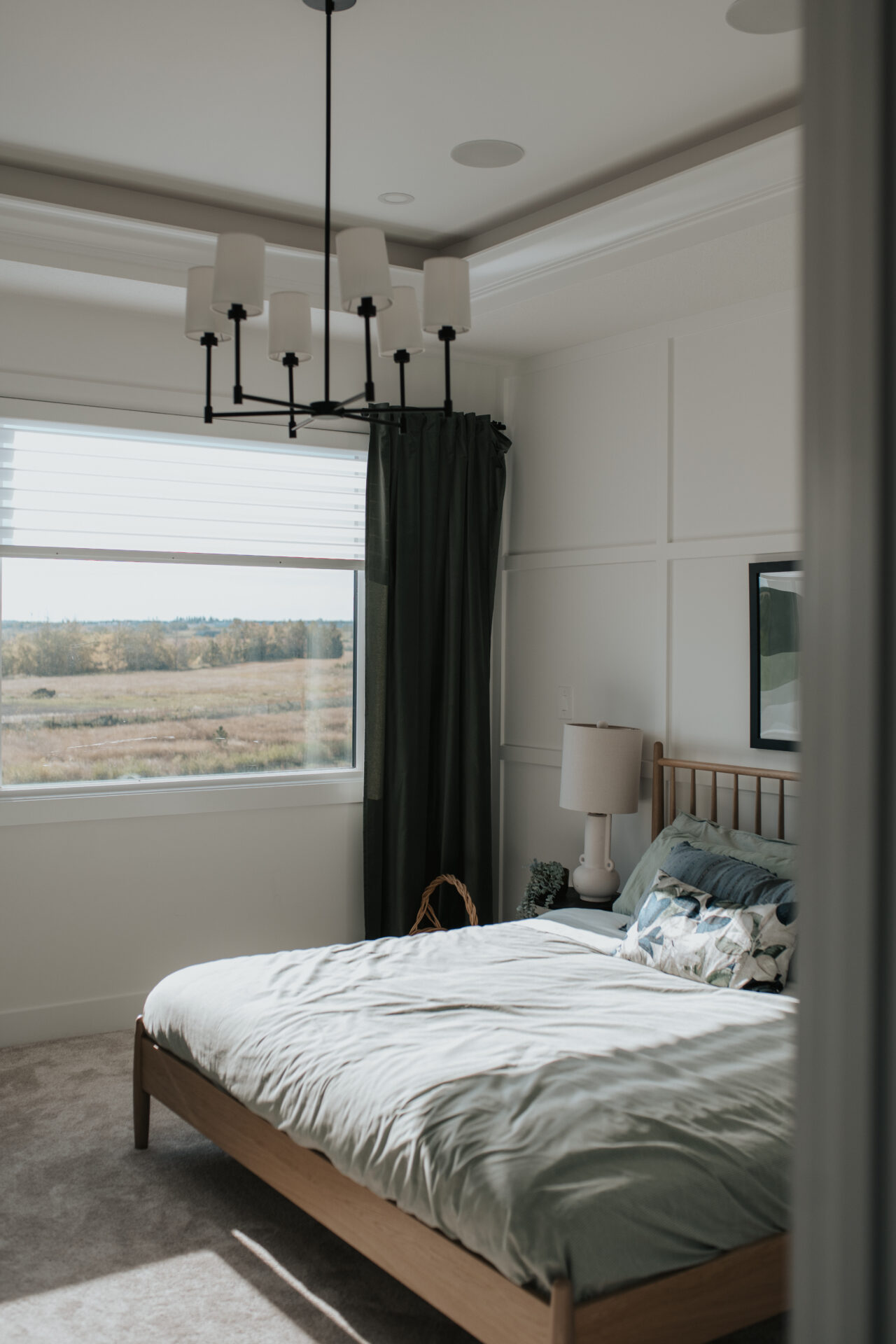
What to pick:Blackout cellular (honeycomb) shades with side tracks. Double-cell fabric gives you full darkness plus solid insulation — which matters in January when that north-facing window turns into a cold radiator, and in June when the sun doesn’t set until after 10 PM. Why this room first: You will sleep here tonight. Builder-grade blinds — if you got any at all — are almost always a light-filtering roller in a generic width that doesn’t reach the edges. Light leaks around all four sides. After a few nights of 4:45 AM sunrise cutting across your pillow, you will understand why this room gets priority. Price range: $220 to $380 per window for custom-fit double-cell blackout. Most primary bedrooms have 2 to 3 windows, so expect $500 to $1,100 for the room. Upgrade option: Add motorized lift if the windows are above a headboard or hard to reach. One tap to close everything before bed — no climbing over furniture. Motorized blinds add roughly $150 to $250 per window to the base price.Kids’ Bedrooms
What to pick:Cordless blackout rollers with side channels. Same blackout priority as the primary bedroom, but rollers are a bit more budget-friendly and the clean, flat profile works well in smaller rooms. Why blackout here too: If you have young kids — especially toddlers or babies — blackout is non-negotiable for naps. Edmonton’s summer daylight makes a 1 PM nap feel like mid-morning behind a light-filtering shade. (We have an entire guide on blackout blinds for nurseries if you want the deep dive.) Price range: $160 to $290 per window. A kids’ bedroom with 2 standard windows runs $320 to $580. Safety note: Every product we install is cordless. No dangling chains, no loop cords. This is standard across our entire line — not an upgrade.Living Room / Great Room
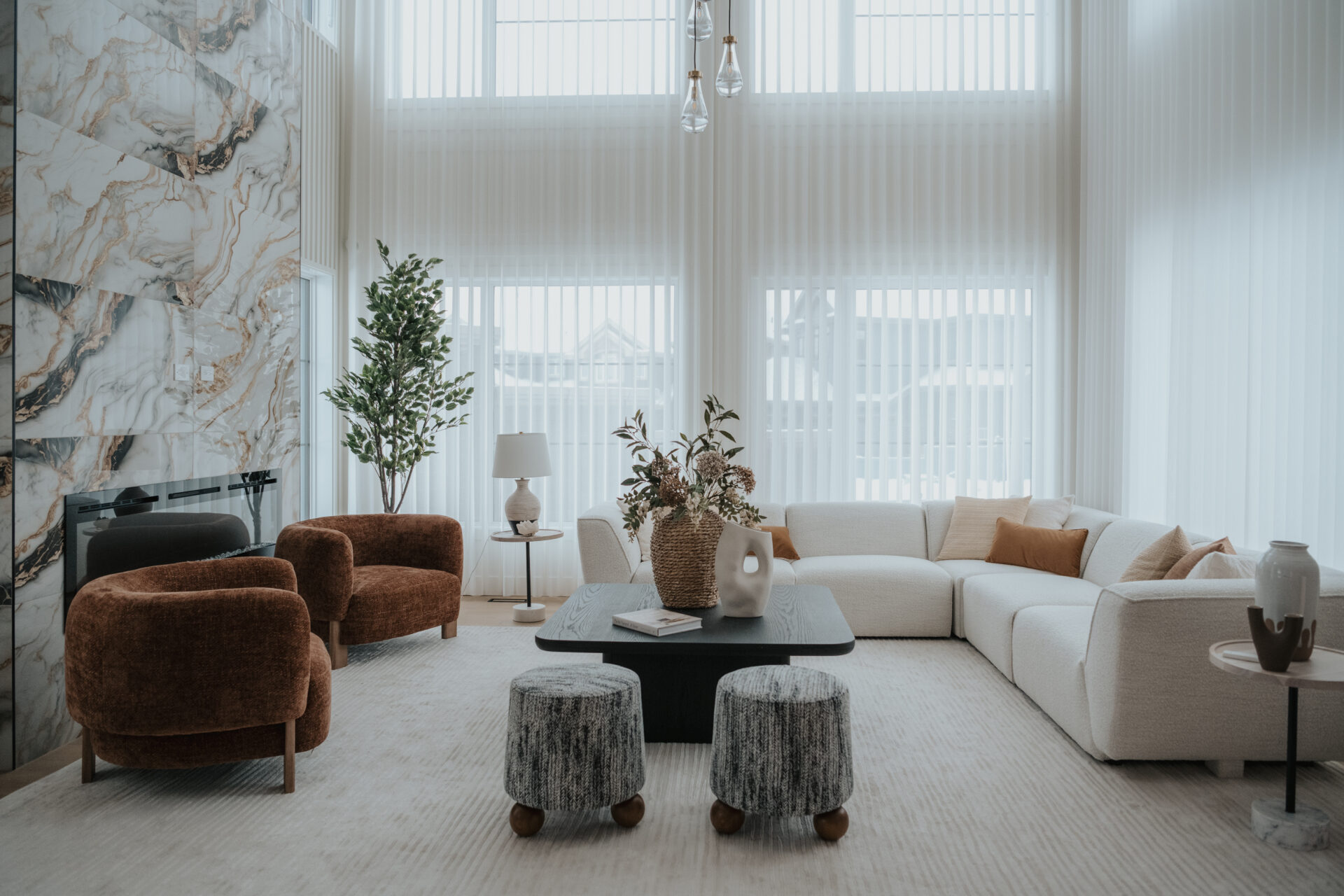
What to pick:Zebra blinds. These alternate between sheer and opaque bands, so you can shift from full privacy to filtered daylight without raising the shade. In an open-concept great room — which is essentially every new build south of the Henday — zebra blinds give you the light control of a sheer curtain and the privacy of a roller in one product. Why zebra for this room: New Edmonton homes in communities like Cavanagh, Keswick, and Windermere tend to have oversized windows in the main living area. Builders love the look — big glass, open sight lines, lots of natural light. But that also means these are the windows your neighbours see straight into at 8 PM. Zebra blinds solve the privacy problem without turning the room into a cave. Price range: $200 to $380 per window. A great room with 3 to 5 large windows runs $700 to $1,900 depending on width. Upgrade option: Motorized zebra blinds on a group channel, so all 4 or 5 windows in the great room move in sync with one remote press. If you’re going to motorize any room, this is the one that benefits most — reaching across the couch to pull down a wide shade every evening gets old fast.Kitchen
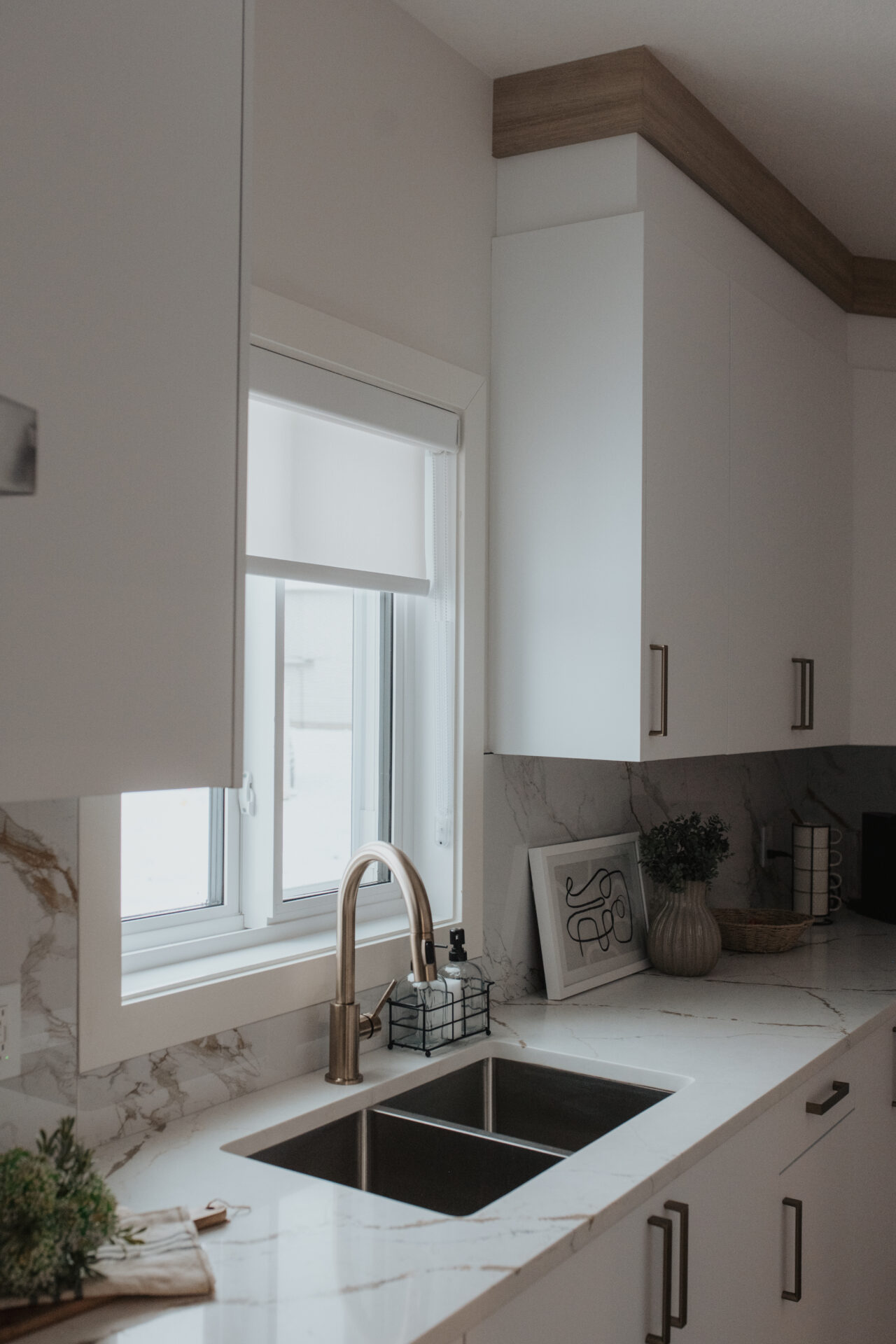
What to pick:Light-filtering roller shades in a wipeable PVC or vinyl-coated fabric. The kitchen window is usually above the sink, close to the stove, and exposed to cooking grease and steam. You want something you can wipe down with a damp cloth, not a fabric that absorbs oil and yellows over six months. Why rollers here: Cellular and zebra fabrics are harder to clean. Rollers in a smooth-face fabric resist moisture and grease far better. Skip the blackout — you want daylight while cooking. A 5% or 10% openness light-filtering fabric blocks UV and cuts glare without making the kitchen feel dim at 6 PM in December. Price range: $140 to $260 per window. Most kitchens have 1 to 2 windows, so the room total is usually under $500. For a full breakdown of kitchen-specific options, see our guide on the best blinds for kitchen windows.Bathrooms
What to pick:Top-down / bottom-up cellular shades in a moisture-rated fabric, or a roller shade in vinyl-coated fabric. Top-down / bottom-up lets you drop the shade from the top for privacy while keeping the upper portion open for ventilation and light — useful in a bathroom where the window is often the only natural light source. Why last in priority: Bathroom windows are small, and most new builds place them high enough that privacy isn’t urgent. These are also the cheapest windows in the house to cover. If budget is tight, a basic moisture-safe roller at $120 to $200 per window does the job. Price range: $120 to $280 per window. Two bathrooms with one window each: $240 to $560 total. Watch out for: Faux-wood blinds marketed as “moisture-resistant.” They hold up, but they collect dust in every slat and are tedious to clean in a humid room. A smooth roller or cellular is easier to maintain long-term.Home Office
What to pick:Light-filtering roller shades or zebra blinds — your choice depends on whether you take video calls. Rollers give a clean, minimal backdrop. Zebra blinds let you tune the light level throughout the day without raising and lowering the shade, which is helpful if your desk faces a west window and the afternoon sun turns your screen into a mirror. Price range: $160 to $340 per window. A home office with 1 to 2 windows runs $160 to $680. Tip: If you are on camera regularly, avoid anything with horizontal lines or busy texture behind you. A solid roller in a neutral tone — warm grey, linen, soft white — photographs better than a patterned zebra band at half-open. Try it in our Novo Visualizer to see how different fabrics look against your wall colour.Basement
What to pick:Double-cell honeycomb shades for energy efficiency. Basement windows lose heat fast in winter — they are at or below grade, smaller, and often single-pane in older homes (though new builds usually have double-pane). Cellular shades add a layer of insulation that keeps the basement usable year-round without cranking the heat. Price range: $140 to $260 per window. Basements in new builds typically have 2 to 4 small windows, so the room total is $280 to $1,040. Blackout option: If the basement doubles as a media room or guest suite, go blackout cellular. Same price range, and the small window size means even blackout fabric won’t make the room feel oppressive — you can always raise the shade fully for daylight.Our Work
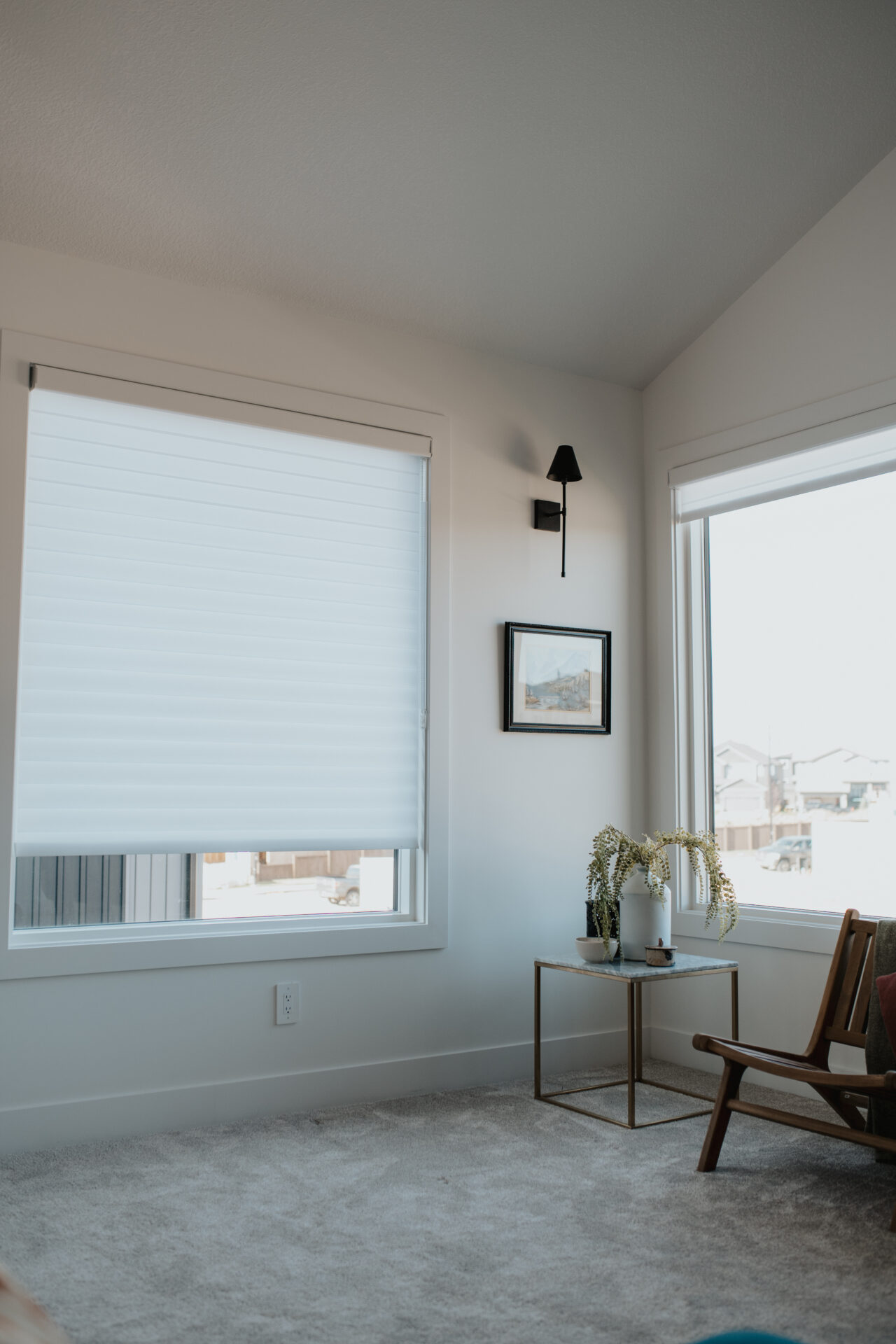
New-home installations across Edmonton.
Bonus Room / Playroom
What to pick: Cordless light-filtering rollers in a durable fabric. This room takes the most abuse in a family home — kids, toys, pets. Rollers are simple, low-profile, and harder to damage than cellular or zebra fabric. Light-filtering (not blackout) keeps the room bright for play during the day. Price range: $160 to $280 per window. A bonus room with 2 to 3 windows: $320 to $840. Skip the upgrade here: Unless you specifically need motorized control, keep this room basic. Put the motorized budget toward the great room or primary bedroom where it makes more of a day-to-day difference.The Order of Operations
If you can do everything at once, great — one measurement visit, one install trip, done. But most new homeowners are juggling appliance deliveries, furniture orders, and the fact that a down payment just emptied their savings account. Here’s how to phase it if you need to spread the cost over a few months. Phase 1 — move-in week (budget: $1,200 to $2,400): Primary bedroom, kids’ bedrooms. You need sleep. Everything else can wait a few weeks behind temporary paper shades or a hung blanket. Phase 2 — month two (budget: $800 to $2,000): Living room / great room. This is where you spend your waking hours, and where the privacy gap is most obvious with big bare windows. Phase 3 — month three (budget: $600 to $1,500): Kitchen, bathrooms, home office. Smaller windows, lower urgency. Phase 4 — when you’re ready (budget: $400 to $1,200): Basement, bonus room, any remaining windows. These rooms can function fine with bare windows for a while — they tend to face the backyard or have small, high-set glass that doesn’t create privacy issues.The Edmonton New-Build Angle
South Edmonton is in the middle of a building boom. Communities like Cavanagh, Keswick, and Windermere are handing over dozens of new homes every month. The builds share a few traits that affect your window covering choices: Open floorplans with big glass. The main floor is typically one continuous space — kitchen, dining, and great room — with oversized windows along the south or west wall. That is a lot of glass to cover, and it means your living-area blinds are the visual anchor of the entire main floor. Choose something that looks intentional, not like an afterthought. High ceilings on the main floor. Nine-foot ceilings are standard, and some great rooms go to ten or twelve feet. That affects the maximum drop of your blinds and can push you toward motorized lift — manually reaching a shade at 108 inches is awkward at best. Consistent window sizes. Builders use a limited set of window dimensions, which is actually good news. It means we can measure and produce 15 to 20 windows in a single order with minimal variation. That keeps production efficient and pricing consistent. Possession timelines shift. Builders quote move-in dates that can slide by weeks or months. We recommend scheduling your measurement visit as soon as you have a confirmed possession date — not when you get the keys. Custom blinds take 3 to 5 weeks to manufacture, and the earlier we measure, the closer your install date lands to move-in day.Common Mistakes We See on New Builds
- Waiting until the furniture is in to measure. Furniture doesn’t change your window dimensions. Measure early, install early. You’ll be glad the blinds are up when the movers arrive.
- Buying big-box temporary blinds “just for now.” Those $30 cordless paper shades look fine for a week. Then they yellow, warp, and fall off the brackets. Most people spend $200 to $400 on temporary coverings that go in the garbage two months later. That money is better put toward the real thing.
- Going all-blackout everywhere. Blackout is essential in bedrooms. In the living room and kitchen, it makes the space feel closed off and you end up raising the blinds all day anyway. Light-filtering or zebra in common areas, blackout in sleep spaces.
- Ignoring the west wall. Edmonton’s summer sun tracks across the northern sky, and the afternoon west exposure is brutal from May to August. South-facing glass gets attention, but west-facing windows in a great room or home office can push indoor temps past 28 degrees by 4 PM. Prioritize UV-blocking fabric on the west side.
- Skipping the measurement visit. New-build windows are not always the size that appears on the floor plan. Framing tolerances, drywall returns, and casing profiles all affect the final measurement. We measure every window on site, to the nearest eighth of an inch. Do not order blinds from your floor plan dimensions.
What We’d Recommend — The New-Home Package
If you handed us the keys to a typical three-bedroom, 2.5-bath new build in south Edmonton and said “cover everything,” here’s what we’d spec:- Primary bedroom (3 windows): Double-cell blackout honeycomb with side tracks, motorized lift
- 2 kids’ bedrooms (4 windows): Cordless blackout rollers with side channels
- Great room (4 windows): Motorized zebra blinds, grouped on one channel
- Kitchen (2 windows): Light-filtering vinyl-coated rollers
- 2.5 bathrooms (3 windows): Moisture-rated top-down/bottom-up cellular
- Home office (2 windows): Light-filtering rollers
- Basement (3 windows): Double-cell honeycomb, blackout
- Bonus room (2 windows): Cordless light-filtering rollers
Book Your Measurement
We do free in-home consultations across Edmonton and surrounding communities. The visit takes about 45 minutes for a full house — we measure every window, talk through your priorities room by room, and leave you with a written quote within 48 hours. No deposit required to get the quote. If you want to experiment with colours and styles before the visit, try our Novo Visualizer — upload a photo of your room and see how different products look against your walls and flooring. Ready to get started? Book your free consultation or call us at (780) 340-0043.Frequently Asked Questions
How long does it take to get custom blinds installed in a new Edmonton home?
From measurement to install, plan for 3 to 5 weeks. That is our standard manufacturing lead time for custom-fit product. If you schedule the measurement visit before your possession date, we can often have blinds ready to install within the first two weeks of move-in. Read more about lead times and how to plan ahead.Can I install blinds before my furniture arrives?
Yes, and we recommend it. Our installers only need access to the windows — no furniture needs to be in place. Getting blinds installed before the movers arrive means you have privacy and light control from day one, and there’s no risk of furniture blocking window access during the install.What is the cost of window coverings for a whole new home in Edmonton?
For a typical three-bedroom home with 18 to 25 windows, expect $3,000 to $8,000 depending on product choices and how many windows you motorize. Basic roller shades across the board land near the lower end. A mix of honeycomb, zebra, and motorized products pushes toward the higher end. We provide a detailed written quote after the measurement visit — no surprises.Do I need blackout blinds in every room?
No. Blackout is essential in bedrooms — especially with Edmonton’s extreme summer daylight — but overkill in most other rooms. Living areas, kitchens, and home offices are better served by light-filtering products that control glare and UV without blocking all natural light. Save the blackout budget for where you sleep.Should I get motorized blinds for my whole house?
Motorized lift is worth the investment in two situations: large or hard-to-reach windows (great rooms with tall ceilings, windows above headboards) and rooms where you want group control of multiple shades at once. For standard-height windows you reach easily, manual cordless operation works fine and costs significantly less. Most homeowners motorize the great room and primary bedroom, and go cordless manual everywhere else.Are your blinds safe for homes with young children?
Every product we manufacture and install is cordless — no chains, no loop cords, no pull strings. This is standard across our entire line, not an add-on. Motorized blinds add an extra layer of child safety since there’s no manual interaction with the shade at all. For nursery-specific recommendations, see our nursery blackout guide.Just got the keys?
Free in-home measurement for your whole house. We bring samples, measure every window, and manufacture right here in Edmonton.
Book free consultationServing