

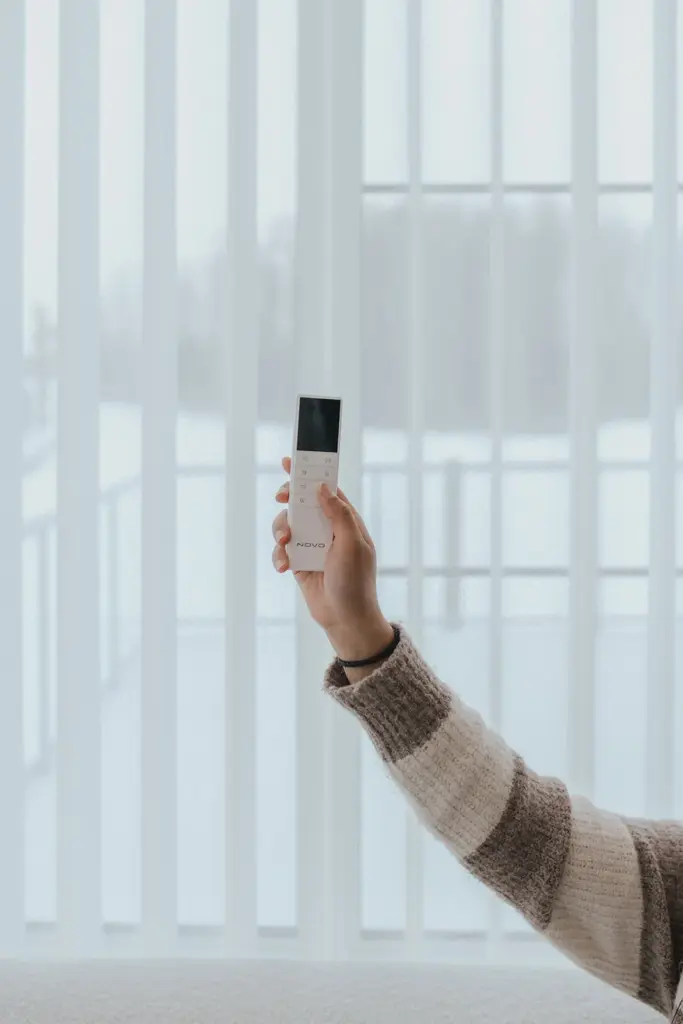
Novo Blinds · Edmonton
The Smart Home Blinds Setup: How Motorized Fits Your Edmonton Tech Stack
Already have a smart speaker and thermostat? Motorized blinds complete the loop — schedules, voice control, energy savings. How it works in Edmonton homes.
Smart-Ready
Motors
3–5 wk
Lead Time
4.8★
Google Rating
You have a smart speaker on the kitchen counter. The thermostat adjusts itself when you leave the house. The living room lights dim at 9 PM without anyone touching a switch. Your ceiling fan kicks on at 23 degrees. By most definitions, you have a smart home — and then 4 PM rolls around on a July afternoon. The west-facing windows in your living room are dumping solar heat into the house. The thermostat sees the temperature climbing and cranks the AC harder. The smart system you spent two years building is fighting itself — cooling a house that keeps getting warmer because nobody closed the blinds. That is the gap motorized blinds fill. They are not a luxury add-on. They are the piece that connects your climate control to the actual source of the heat.
The short answer
Motorized blinds connect to your existing smart home hub — Alexa, Google Home, or Apple HomeKit. You set schedules, issue voice commands, or let your thermostat trigger them automatically. The installation is the same as manual blinds. We measure, build, and mount the blind the same way. The motor adds about 90 seconds to the install per window, and the pairing to your hub takes five minutes total once we are done.What Motorized Blinds Actually Do
There is a perception that motorized blinds are complicated — that they need special wiring, a dedicated hub, or a degree in home automation. They do not. Here is what a motorized blind actually does, stripped down to basics. Lift and lower on command. Press a button on a remote, tap your phone, or say the word. The motor raises or lowers the blind to any position you set — fully open, fully closed, or anywhere between. Roller shades go up and down. Cellular shades go up and down. Blackout blinds go up and down with full light seal if they are in side-track channels. Same products you would buy manually, with a motor added inside the headrail. Group by room or zone. Set “living room” as a group and every blind in that room moves together. Set “west side” and every west-facing blind in the house responds at once. You do not walk window to window. Run on a schedule. Open at 7 AM, close at 4 PM, half-position at sunset. The schedule runs whether you are home or not, whether your phone is charged or not. It lives on the hub. Accept voice commands. “Alexa, close the bedroom blinds.” “Hey Google, set living room blinds to 50%.” “Siri, close all blinds.” The motor responds in 2 to 4 seconds. Run on battery or hardwired power. This is the myth worth dispelling early: motorized blinds do not need to be plugged into an outlet. Battery-powered motors are the default for most residential installs. A rechargeable lithium pack sits inside the headrail — invisible from the room. You recharge it every 6 to 12 months with a USB-C cable. No electrician needed, no cords running down the wall.How They Fit Your Existing Setup
This is the section that matters most for the homeowner who already owns smart devices. You are not starting from scratch. You are adding one more layer to a system that already works.Voice assistants — Alexa, Google Home, Siri
Our motorized systems pair with all three major voice platforms. The motor connects to your home WiFi network (or to a small bridge that plugs into your router — depends on the motor series). Once paired, the blinds show up as devices in your Alexa app, Google Home app, or Apple Home app. From there, voice control works the same way it does for your lights or thermostat. Practical commands people actually use:- “Alexa, good morning” — opens bedroom blinds, turns on kitchen lights, starts the coffee maker. One routine, three devices.
- “Hey Google, close the office blinds” — useful during a video call when glare hits the camera mid-afternoon. If you work from home, this one pays for itself in the first week. (More on managing glare in your home office.)
- “Siri, I’m leaving” — closes all blinds, locks the door, arms the system.
Smart thermostats — the energy play
This is where motorized blinds stop being a convenience feature and start being a climate control tool. Your thermostat knows the indoor temperature. Your blinds control how much solar heat enters through the glass. Connect the two and the house manages itself. The setup: create an automation that triggers your west-facing blinds to close when the indoor temperature passes a threshold — say, 24 degrees. The thermostat reports the temperature to the hub, the hub triggers the blind group, and the blinds close before the AC has to ramp up. The AC still runs if needed, but it is working against less heat gain. In an Edmonton summer, west-facing windows can push 800 to 1,000 watts of solar heat per square metre of glass during peak afternoon hours. That is real thermal load. Closing a roller shade with a solar-reflective fabric cuts 60% to 80% of that gain before it ever reaches the room. Closing a honeycomb shade adds an insulating air pocket on top of that. We covered the broader cooling math in our post on keeping your Edmonton home cool without AC. The motorized layer adds automation — you do not have to remember to close the blinds at 3 PM because the system does it for you.Lighting scenes — the sunset routine
If you already run Hue bulbs or any smart lighting, you know about scenes: “Movie night dims the lights to 20% and sets them warm.” Motorized blinds slot into those same scenes. A sunset routine for an Edmonton living room might look like this: at 9:15 PM in June (or whenever local sunset hits), the blinds lower to 75%, the overhead lights shift to 2700K warm, and the floor lamp comes on. The room transitions from daylight to evening without anyone touching a switch or a cord. In December, that same routine fires at 4:30 PM — the schedule adjusts with the season if you use a sunrise/sunset trigger instead of a fixed time.Security — away-mode randomized schedules
Empty houses with blinds frozen in one position for a week look empty. Smart home security systems already randomize lights to simulate occupancy. Motorized blinds add the second half of that illusion. Set a vacation routine: blinds open at slightly different times each morning (randomized within a 30-minute window), close partway in the afternoon, close fully after dark. Pair that with randomized lights and the house looks occupied from the street. This is especially useful in newer Edmonton neighbourhoods — Windermere, Keswick, Glenridding — where homes sit close together and street visibility is high. (For homeowners in that area, we have a dedicated page on custom blinds in Windermere.)Battery vs. Hardwired — Honest Tradeoffs
There are two power options for motorized blinds. Both work. The right choice depends on your house and your tolerance for maintenance.Battery-powered
The upside: Installation is identical to a manual blind. No wiring, no electrician, no holes in the wall beyond the standard mounting brackets. The rechargeable battery pack sits inside the headrail. You pop it out, plug it in with a USB-C cable for 4 to 6 hours, snap it back in. Total effort: 2 minutes of your time, twice a year. The downside: You do have to remember to recharge. Battery life depends on usage — a blind that moves twice a day lasts 10 to 12 months. A blind in a high-traffic room that moves 6 to 8 times daily might need a recharge every 4 to 5 months. A low-battery notification pops up on your phone app 2 weeks before the motor stops, so you are not caught off guard. Best for: Retrofit installs, rental properties, homes where running new wiring is not practical or cost-effective.Hardwired
The upside: Plug it in and forget it. The motor draws power continuously from a standard outlet or an in-wall low-voltage line. No battery to recharge, no notifications to manage. It just works, indefinitely. The downside: You need power at the window. If there is an existing outlet within 1 to 2 feet of the headrail, great — a slim power cord runs from the headrail to the outlet and tucks behind the frame or trim. If there is no outlet, you need an electrician to run a line — typically $150 to $350 per window for the electrical work, on top of the blind cost. New-construction homes can spec low-voltage wiring to every window during the build phase for a fraction of that cost. Best for: New construction, major renovations, or any window where you want zero-maintenance automation. Our recommendation: For most Edmonton retrofits, battery is the right call. The recharge cycle is painless, the install is simpler, and the cost is lower. Hardwired makes sense if you are building new or already have electrical open for a renovation.Our Work
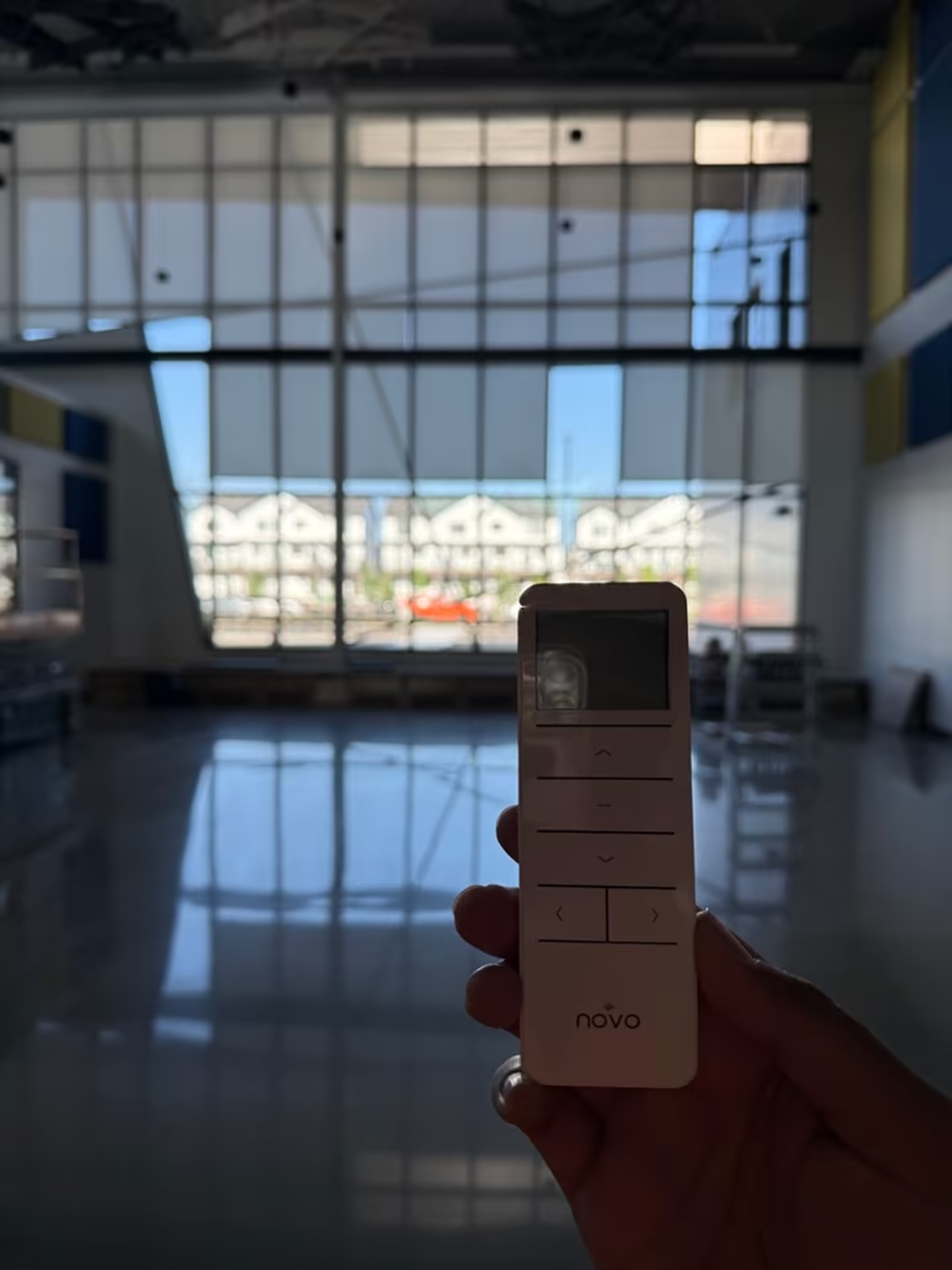
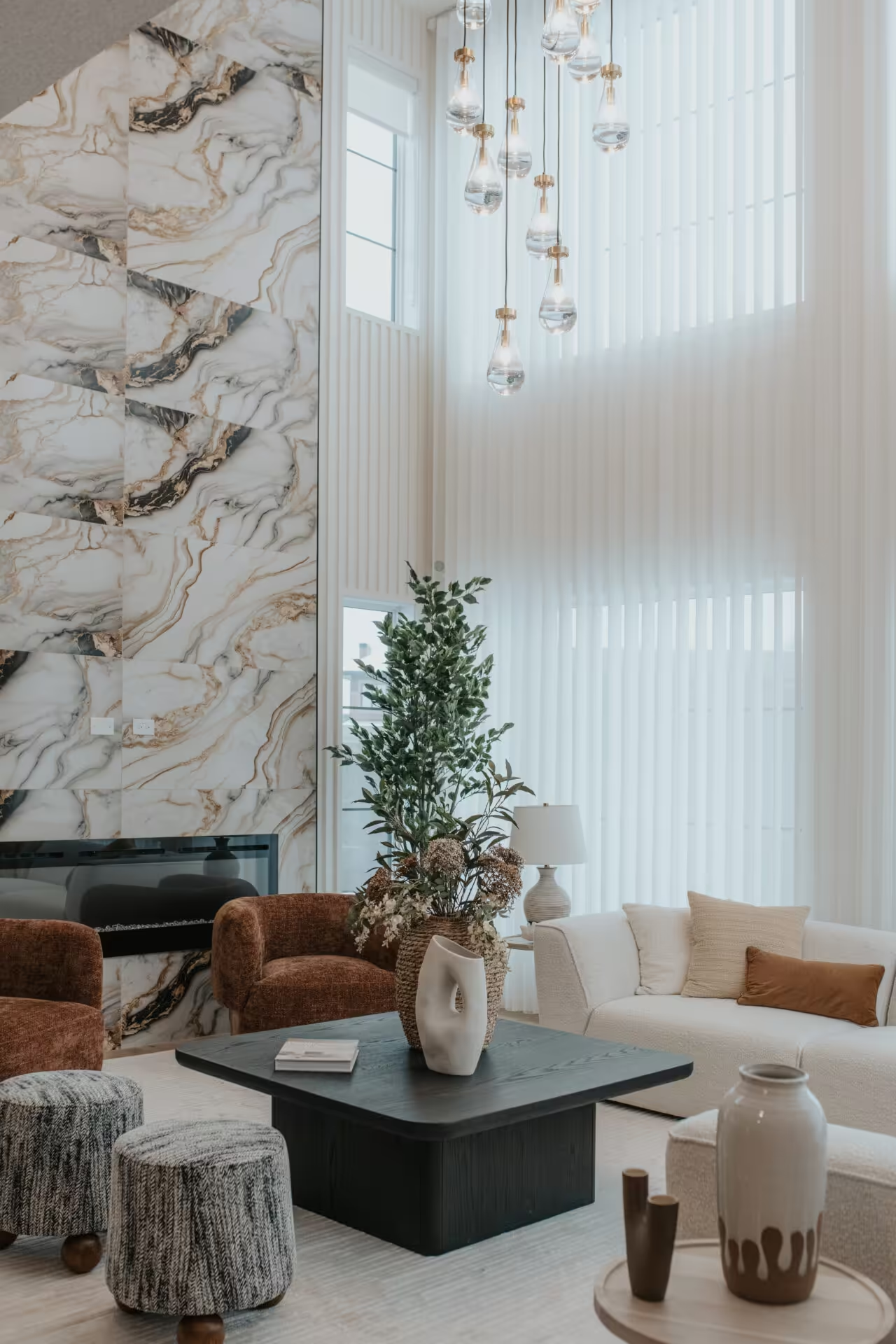
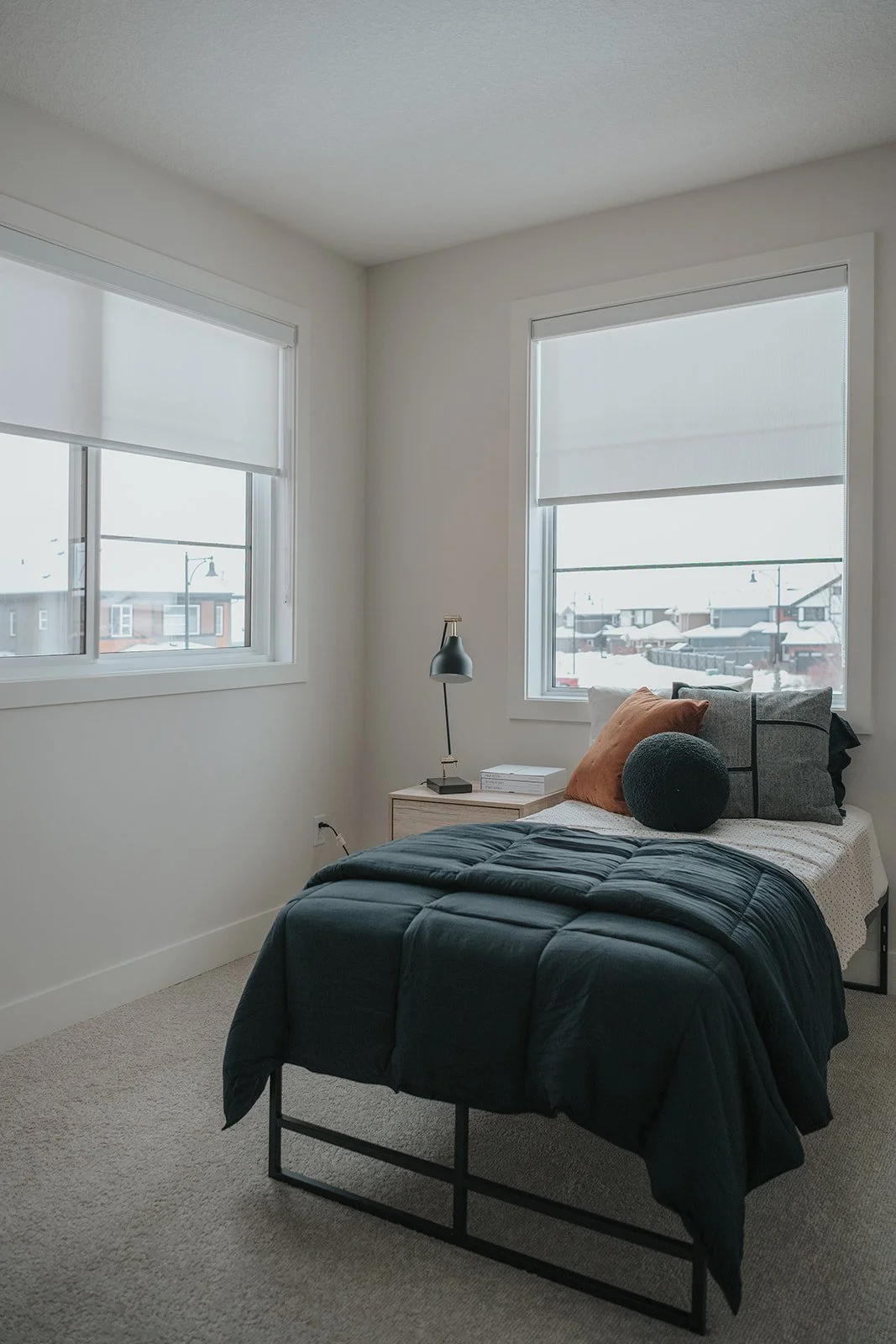
Smart motorized installs in Edmonton.

The Edmonton Energy Angle
Edmonton’s latitude means extreme swings in daylight — 17 hours of sun in June, 7.5 hours in December. That swing creates two distinct energy challenges, and automated window coverings address both. Summer: West and south-facing windows absorb serious solar heat between 2 PM and 8 PM from May through August. In a house with 6 west-facing windows (common in newer two-storey builds in Windermere, Summerside, or Walker), the cumulative solar gain is enough to push the AC an extra 1.5 to 2.5 hours of run time per day. Motorized blinds on a 2 PM close schedule eliminate the lag between when the sun hits and when someone remembers to close the blinds — because most people forget, or they are at work. Winter: The same automated blinds open at sunrise to capture passive solar gain — free heat through south-facing glass — then close at sunset to add a layer of insulation against -25 degree nights. A honeycomb shade adds roughly R-3 to R-4 to the window assembly. Across 10 windows, that is a measurable dent in your heating load from November through March. The payback math: Motorized blinds are not an energy product first. The energy savings — typically $150 to $400 per year depending on house size, window count, and HVAC system — contribute to long-term payback but do not justify the purchase alone. The real value is comfort, convenience, and the fact that the system actually runs the schedule every day. Manual blinds have the same potential savings, but only if someone closes and opens them consistently. Most people do not.What It Costs
Let’s put real Edmonton numbers on this. Manual blind (custom, installed): $120 to $350 per window depending on product. A standard roller shade in light-filtering fabric lands around $140 to $220. A double-cell honeycomb runs $200 to $340. A blackout roller with side tracks is $250 to $400. Motorized upgrade: Add $80 to $180 per window on top of the manual price. That covers the motor, battery pack, and pairing to your hub. The blind itself is the same product — same fabric, same fit, same warranty. Total per window (motorized, installed): $200 to $530 depending on product and features. Whole-house example: A typical Edmonton two-storey with 12 to 16 windows runs $3,500 to $7,500 for a full motorized package — every window, measured, built, installed, and paired. That is for custom-fit blinds built to your window dimensions, not stock-size kits from an online retailer. Hub or bridge cost: $0 to $80, depending on the motor series. Some pair directly to WiFi. Some need a small bridge that plugs into your router. We include the bridge in the quote if the motor requires one.Common Mistakes
Five things we see homeowners get wrong with smart home blinds:- Buying motor-only kits online and expecting plug-and-play. Retrofit motor kits sold on Amazon are designed for specific tube diameters and blind widths. If the motor does not match the headrail, the blind jams or stalls. We have replaced DIY motors that burned out in under 6 months because the torque rating was wrong for the blind weight.
- Not checking hub compatibility before buying. Not every motor works with every hub. Some are WiFi-only and skip Apple HomeKit. Some need a proprietary bridge that only pairs with Alexa. If you are committed to Google Home, confirm the motor supports it natively — not through a workaround or a third-party middleware app that breaks every firmware update.
- Forgetting about battery recharging. Battery motors are convenient until you have 14 of them and lose track of which ones need charging. Our app sends low-battery alerts, but you still need a system — label each battery pack, keep a spare charged, or set a calendar reminder for the whole house every 8 months.
- Skipping the bridge and relying on Bluetooth-only. Some budget motors pair via Bluetooth to your phone but have no hub integration. That means no voice control, no schedules, no thermostat automation — you are just using your phone as a remote. If smart home integration is the point, confirm the motor has WiFi or Zigbee connectivity.
- Motorizing every window when only the west and south side matter. North-facing windows get minimal solar gain. East-facing windows get morning sun that most people welcome. The biggest return on motorized blinds is on west and south exposures — the windows that cause the afternoon heat spike. Motorize those first. Add the rest later if you want whole-house control.
What We’d Recommend
If you have Alexa or Google Home and a smart thermostat: Start with your west-facing windows. Motorized roller shades in a solar-reflective fabric, paired to a 2 PM close schedule and a thermostat-triggered automation. This is the setup that makes the biggest immediate difference — you will feel it the first week in July. If you want whole-house automation: Motorized honeycomb shades on every window. Battery-powered for retrofit, hardwired if you are building new. Group by room and by exposure (west side, south side, bedrooms, common areas). Build routines for morning, afternoon, sunset, and away mode. Budget $4,500 to $7,500 for a 12- to 16-window house. If you work from home: Motorized blackout or light-filtering shades in the office, paired to a voice command or a one-tap phone shortcut. Glare control during video calls without standing up mid-meeting. Pair with the Novo room visualizer to see what the shade looks like in your actual space before you commit. If you want to start small: One room, 2 to 3 windows, battery motors. Pick the room where you close the blinds most often — usually the primary bedroom or the west-facing living room. Total investment: $400 to $900. Live with it for a month. You will motorize the rest.Book a free in-home consultation and we will measure your windows, confirm hub compatibility, and walk you through motor options on the spot. We serve Edmonton and the surrounding metro — Sherwood Park, St. Albert, Leduc, Spruce Grove, Fort Saskatchewan, Beaumont, Stony Plain, Grande Prairie, and Red Deer. Call 780-245-0190 or request a quote online. Browse our recent installs to see what motorized setups look like in Edmonton-area homes.
FAQ
Do motorized blinds work with Alexa and Google Home?
Yes. Our motorized systems pair with Alexa, Google Home, and Apple HomeKit. Once the motor connects to your WiFi network (or to a bridge on your router), the blinds show up as devices in your existing smart home app. Voice commands, routines, and automations all work the same way they do for your lights or thermostat.Do motorized blinds need to be plugged in?
Not necessarily. Battery-powered motors are the standard for most residential installs. A rechargeable lithium battery sits inside the headrail and lasts 6 to 12 months between charges. You recharge with a USB-C cable in 4 to 6 hours. Hardwired options are available if you prefer zero-maintenance power — they just need an outlet or in-wall wiring near the window.How much do motorized blinds cost in Edmonton?
A custom motorized blind in Edmonton typically runs $200 to $530 per window installed, depending on the product type and features. That includes the blind, motor, battery or power supply, and full installation. A whole-house package for 12 to 16 windows ranges from $3,500 to $7,500.Can motorized blinds save on energy costs?
They can. Automated schedules close blinds during peak solar hours and open them for passive solar gain in winter — consistently, every day, without relying on someone to remember. Typical annual savings range from $150 to $400 depending on house size and window count. The bigger benefit is comfort: rooms stay cooler in summer and warmer in winter because the system responds to conditions, not habits.Can I add motorized blinds to windows that already have manual blinds?
In most cases, no — the motor is integrated into the headrail during manufacturing, so a retrofit means replacing the blind rather than adding a motor to your existing one. The good news is the installation process is identical to what you had before. We remove the old blind, mount the new motorized one in the same brackets, and pair the motor to your hub. Total install time per window is about 15 to 20 minutes.What happens if the WiFi goes out?
The blinds still work. Every motorized blind has a physical remote control and can be operated manually via the motor’s built-in button. WiFi is only needed for smart home integration — voice commands, schedules, and automations. If your internet drops, the blinds hold their last position and respond to the remote until connectivity returns. Scheduled routines resume automatically once the hub reconnects.Ready to make your blinds smart?
Free in-home consultation. We match motors to your smart-home setup and install in one visit.
Book free consultationServing